

Reviewed by Althea Edwina Rozario, Managing Partner, Althea & Jacobs Legal Consultants
Last updated
A rental dispute in Dubai usually starts small: a rent increase that looks too high, a security deposit that never comes back, or a notice asking you to leave. When talking it through does not work, the place to take it is the Rental Dispute Centre (RDC), which hears landlord and tenant cases in Dubai instead of the regular courts.
This guide explains how to file a case at the RDC, what it costs, how long it takes and where cases most often go wrong. If you would rather have the case prepared for you, our litigation lawyers in Dubai handle Rental Dispute Centre cases directly, from the first notice through to execution.
To file a rental dispute in Dubai, you submit a memorandum of claim to the Rental Dispute Centre, along with your Ejari-registered tenancy contract and supporting documents, either online through the Dubai Land Department or in person. You pay a fee of 3.5% of the annual rent (minimum AED 500, maximum AED 20,000) and attend a settlement session. If the dispute is not settled, it goes to a hearing and judgment.
Dealing with a rental dispute right now? The first consultation is free, and a lawyer calls back within 24 hours.
What is the Rental Dispute Centre?
The Rental Dispute Centre was set up under Dubai Decree No. 26 of 2013 as the specialised judicial body for disputes between landlords and tenants in Dubai. It sits within the Dubai Land Department for administrative purposes, but its committees are led by judges, and their judgments are binding and enforceable.
The Centre applies Dubai’s tenancy law, Law No. 26 of 2007 as amended, together with Decree No. 43 of 2013 on rent increases. Leases in the Dubai International Financial Centre (DIFC) follow their own rules and forum, so if your property is in the DIFC, check where the dispute belongs before you file.
Which rental disputes in Dubai go to the RDC?
Most disagreements under a Dubai tenancy fall within the Centre’s jurisdiction, whether you are the landlord or the tenant. The most common cases are:
- Rent increases that go beyond what the RERA rental index allows, or that were not notified at least 90 days before the contract ends.
- Evictions, including challenges to an eviction notice and landlords’ claims against tenants who have not paid.
- Unpaid rent, including rent cheques that were returned unpaid.
- Security deposits that the landlord refuses to return at the end of the tenancy.
- Maintenance and repairs that are the landlord’s responsibility but have not been carried out.
- Renewal and early termination, including disputes over whether a lease can be renewed or ended before its term.
Before you file: try to resolve it in writing
The Centre will try to settle your case anyway, so it pays to make a clear, documented attempt first. Write to the other side, set out what you want and by when, and keep proof that they received it.
For some steps, the law is strict about how notice is given. An eviction at the end of a lease for sale, personal use or major works needs 12 months’ notice through a notary public or registered mail, and changes to the rent or terms at renewal need notice at least 90 days before the contract expires. Our guide to legal notices in the UAE explains when a formal notice is required and how to serve one properly.
Documents you will need
A rental case is won or lost on its documents, so gather everything before you file. The Centre will usually expect:
- The tenancy contract and its Ejari registration certificate.
- Emirates ID and passport copies for individuals, or the trade licence and the signatory’s documents for a company.
- Proof of payments, such as cheque copies, bank transfers and receipts.
- Any notices sent or received, with proof of delivery.
- Correspondence with the other side, including emails and WhatsApp messages kept in their original form.
- Photos, maintenance requests or inspection reports, where the dispute is about the property’s condition.
- A power of attorney, if someone is filing on your behalf.
Documents that are not in Arabic generally need to be translated, and using court-approved legal translators avoids delays when the papers are reviewed.
How to file a case at the RDC, step by step
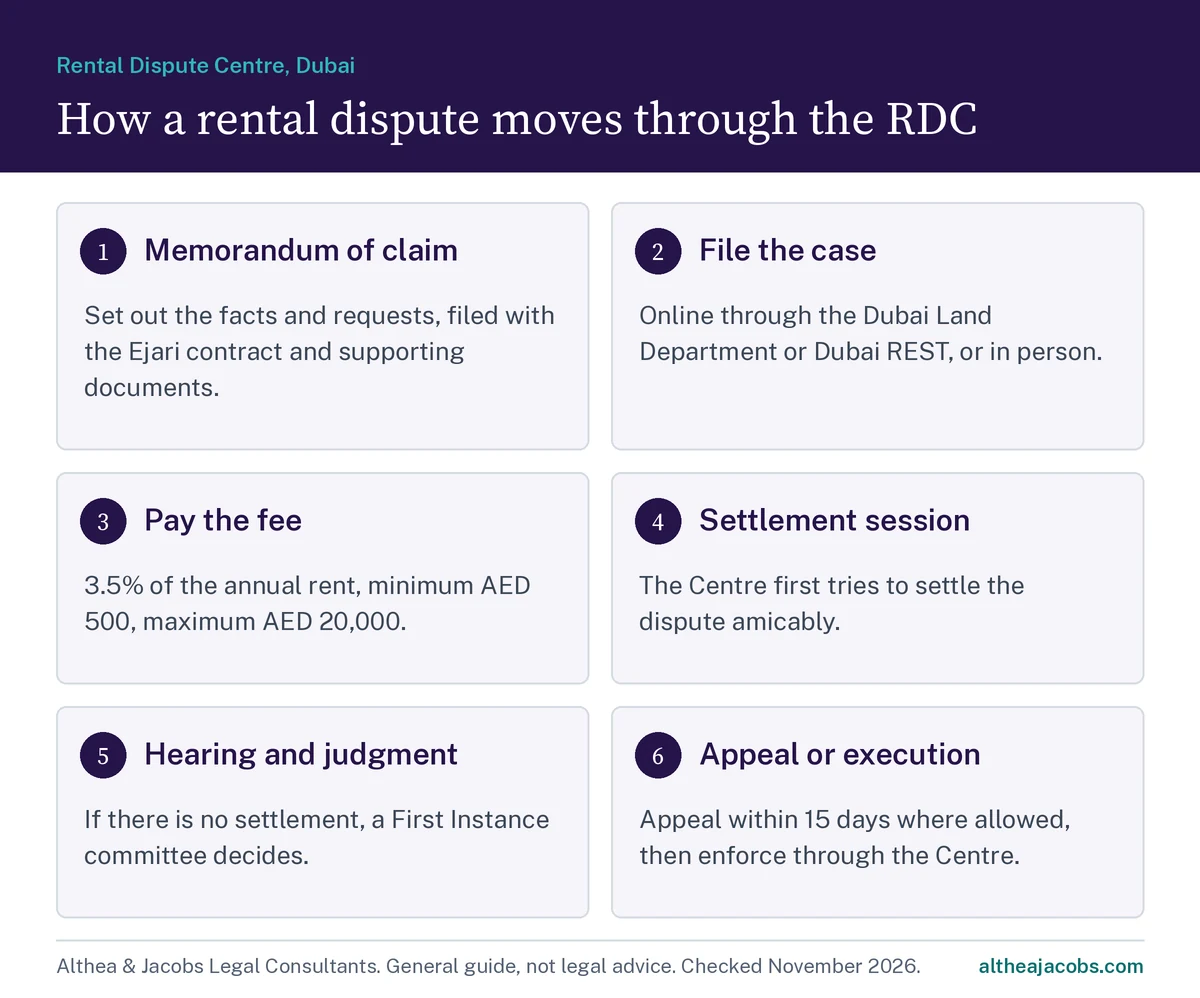
- Prepare a well-drafted memorandum of claim. It sets out the facts, what you are asking the Centre to order and the basis for each request. It is filed along with the supporting documents, so make sure every point in it can be proved by a document.
- Submit the case. Cases can be filed online through the Dubai Land Department’s website or the Dubai REST app, or in person at the Rental Dispute Centre and authorised real estate service centres.
- Pay the filing fee. For most rental claims it is 3.5% of the annual rent, with a minimum of AED 500 and a maximum of AED 20,000, plus small administrative and translation charges.
- Attend the settlement session. The Centre first tries to settle the dispute amicably. If both sides agree, the settlement is recorded and becomes binding.
- Hearing and judgment. If there is no settlement, the case is referred to a First Instance committee, which hears both sides and issues a judgment.
- Appeal or execution. Depending on the value of the claim, the judgment may be appealed. Once it is final, it is enforced through the Centre’s own execution process.
How much does an RDC case cost?
The filing fee depends on the type of claim. These are the main fees at the time of writing. The Dubai Land Department publishes the current schedule, and small service and administrative charges are added on top.
| Type of claim | Filing fee |
|---|---|
| Rental claims, such as eviction, renewal, rent increases and termination | 3.5% of the annual rent, minimum AED 500, maximum AED 20,000 |
| Money claims not tied to the annual rent, such as a specific unpaid amount | 3.5% of the amount claimed, minimum AED 500, maximum AED 15,000 |
| Translation of documents | Charged per page by the translator |
For example, a dispute over a flat rented at AED 80,000 a year carries a filing fee of AED 2,800. Legal fees are separate: after a free first consultation, we quote a fixed fee for an RDC case in writing, so you know the cost before you start.
How long does a rental dispute take?
Decree No. 26 of 2013 sets short timeframes for the Centre’s committees, and straightforward cases often conclude within a few weeks to a few months of filing. Cases take longer when an expert has to inspect the property, when documents are missing, or when the judgment is appealed.
Can you appeal an RDC judgment?
An appeal must be filed within 15 days of the judgment. As a general rule, only judgments in claims worth AED 100,000 or more can be appealed. Judgments below that figure are usually final, but Article 17 of Decree No. 26 of 2013 makes exceptions, the most important being eviction judgments, which can be appealed whatever the value of the claim.
Common mistakes that weaken a rental case
- Stopping rent payments during the dispute. This can turn a tenant’s strong case into a landlord’s eviction claim, so ask whether the rent can be deposited with the Centre instead.
- Relying on WhatsApp or email alone where the law requires notice through a notary public or registered mail.
- Filing without the Ejari certificate or the latest version of the tenancy contract.
- Asking for the wrong remedy, or leaving a claim out, because the memorandum of claim was drafted in a hurry.
- Missing the 15-day appeal deadline, which runs from the judgment, not from when you read it.
Do you need a lawyer for the Rental Dispute Centre?
You can file a rental case yourself, and many people do. A lawyer earns their fee in the preparation: choosing the right claim, drafting the memorandum of claim so that it covers every request, organising the evidence, and knowing when a settlement offer is worth accepting.
At Althea & Jacobs, our team handles Rental Dispute Centre cases directly for both landlords and tenants. Speak to our litigation team in Dubai for a realistic view of your case before you pay the filing fee.
Frequently asked questions
Can I file a rental dispute online in Dubai?
Yes. Rental cases can be filed online through the Dubai Land Department’s website or the Dubai REST app, as well as in person at the Rental Dispute Centre. You will need scanned copies of your tenancy contract, Ejari certificate and supporting documents.
How much does it cost to file a case at the RDC?
For most rental claims the fee is 3.5% of the annual rent, with a minimum of AED 500 and a maximum of AED 20,000. Money claims that are not tied to the annual rent are charged at 3.5% of the amount claimed, up to AED 15,000, plus small administrative and translation charges.
Can my landlord evict me before the contract ends?
Only on the grounds set out in Dubai’s tenancy law, such as unpaid rent where the tenant does not pay within 30 days of being notified. Eviction at the end of the lease for reasons such as sale or personal use needs 12 months’ notice through a notary public or registered mail.
Can I stop paying rent while the case is ongoing?
It is risky, because unpaid rent can give the landlord grounds for eviction. Keep paying, or ask whether the rent can be deposited with the Centre while the dispute is decided.
Can I appeal if I lose at the RDC?
You have 15 days from the judgment to appeal. Appeals are generally allowed only where the claim is worth AED 100,000 or more, but eviction judgments can be appealed whatever the value of the claim.
Does the RDC handle disputes over DIFC properties?
Leases in the DIFC follow the DIFC’s own leasing rules and forum, so check where your dispute belongs before filing. We can confirm the right forum during the free first consultation.
Related guides: Legal notice in the UAE: when to send one and what it costs and How to file a civil case in Dubai.
Speak to a lawyer about your rental dispute
Share the contract and the problem in confidence. A lawyer will call you back within 24 hours with a clear view of your options.
- 5.0 Google rating from 17 reviews
- Free first consultation
- Call back within 24 hours
“I really appreciate the honest advice and transparent pricing.”Sophia A., Google review
Office No. 18, 22nd Floor, Tower Plaza Hotel, Sheikh Zayed Road, Dubai. Monday to Friday, 9am to 6pm. The first consultation is free and confidential.
Request a call back
This guide is general information about UAE law and practice, not legal advice. Fees, procedures and online services change, so check the current position for your case or ask our team.
WhatsApp a lawyer