

Reviewed by Althea Edwina Rozario, Managing Partner, Althea & Jacobs Legal Consultants
Last updated
If a customer or business partner owes you a fixed amount and you can prove it in writing, a full lawsuit is often not the fastest way to get paid. A payment order in the UAE lets a court order the debtor to pay within days, without a full trial, provided the debt meets some strict conditions.
This guide explains how payment orders work under the Civil Procedure Law, when you can use one, the steps and costs, and what happens if the debtor objects. For help recovering a debt, our litigation lawyers in Dubai handle legal notices, payment orders and enforcement.
A payment order is a fast-track court procedure under Articles 143 to 150 of the UAE Civil Procedure Law, for a fixed, due debt that is proven in writing. You first serve a written demand giving the debtor at least 5 days to pay, then apply to the court, which decides on the papers within a few working days. The debtor can challenge the order within a short deadline, and the order is enforced through the execution court.
Owed money right now? The first consultation is free, and a lawyer calls back within 24 hours.
What is a payment order?
A payment order is a summary procedure set out in Articles 143 to 150 of Federal Decree-Law No. 42 of 2022, the Civil Procedure Law. Instead of filing a full claim and waiting for hearings, the creditor submits an application with written proof of the debt, and a judge decides it on the papers.
It began as a tool for bills of exchange and promissory notes, but successive reforms widened it to debts confirmed in writing or electronically, and the current law also covers claims under commercial contracts. That makes it one of the most useful tools for businesses with unpaid invoices.
When can you use a payment order in the UAE?
The debt has to meet all of these conditions:
- It is a sum of money of a known, fixed amount, not compensation that a court would need to assess.
- It is due, meaning the payment date has passed and nothing more is needed from you.
- It is proven in writing, for example by a signed invoice, an acknowledged statement of account, a cheque, a contract, or an email or message in which the debtor accepts the debt.
- You have served a written demand on the debtor at least 5 days before applying.
If any of these is missing, the court will refuse the application, and the claim has to follow the ordinary procedure instead, which costs time as well as the fee you have already paid.
When a payment order is not the right tool
- The debtor genuinely disputes the work, the quality of the goods or the amount.
- You are claiming compensation for losses rather than a fixed debt.
- The only evidence of the debt is a verbal agreement or phone calls.
- The contract has an arbitration clause, which needs advice before you choose the forum.
In these situations, a civil case or arbitration is usually the better route.
How to get a payment order, step by step
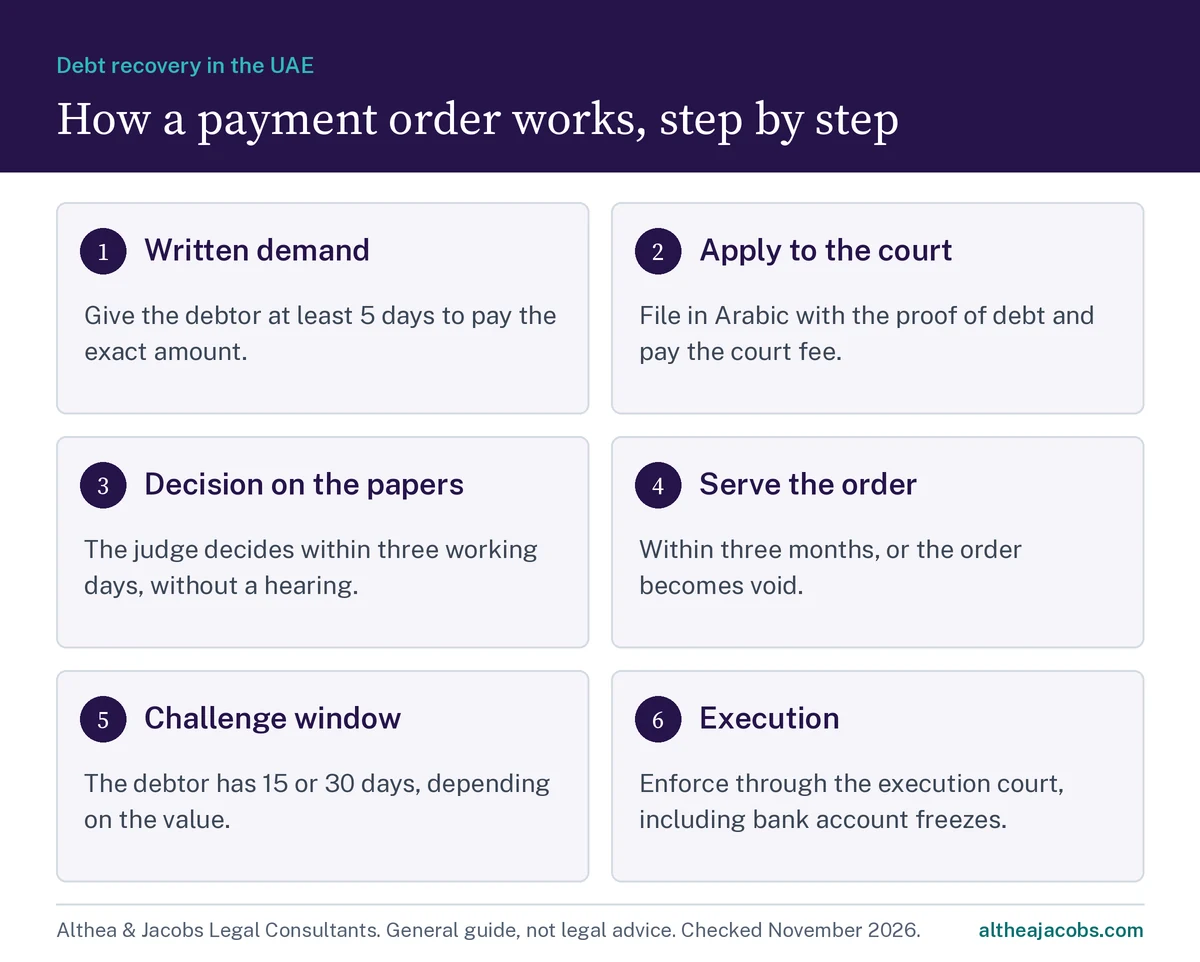
- Gather the proof of the debt. Invoices, delivery notes, statements of account, contracts and any written acknowledgement by the debtor.
- Serve a written demand. Send a legal notice stating the exact amount and giving at least 5 days to pay. Serving it through a notary public gives you clear proof of delivery.
- Apply to the court. Once the deadline passes, file the payment order application in Arabic with the supporting documents, and pay the court fee.
- The judge decides. The court decides on the papers, without notifying the debtor of the application, and must issue its decision within three working days.
- Serve the order. If the order is granted, it must be served on the debtor within three months, or it becomes void.
- Allow for the challenge period. The debtor can challenge the order by grievance or by appeal, depending on its value, within 15 or 30 days of being served.
- Enforce the order. Open an execution file to recover the money through the execution court, which can order measures such as freezing bank accounts.
How long does a payment order take?
Once the 5-day demand has expired, the court decides within days of the application. The whole process, including serving the order and the challenge period, often runs to a few weeks, compared with months for a full case at first instance. If the debtor challenges the order, allow extra time for that to be heard.
How much does a payment order cost?
In Dubai, the court fee for a payment order is calculated in the same way as for a civil claim: 6% of the amount claimed, with a minimum of AED 500 and a cap that depends on the value of the claim. In the federal courts that serve Sharjah, Ajman, Fujairah and Umm Al Quwain, the fee is 4% of the claim, with a minimum of AED 500 and a maximum of AED 45,000, at the time of writing.
The court fee is not refunded if the application is refused, which is why checking the conditions first matters. Notary, translation and execution fees are separate, and our legal fees are quoted in writing as a fixed fee after a free first consultation.
Payment order or full civil case?
| Payment order | Full civil case | |
|---|---|---|
| Best for | Fixed debts proven in writing | Disputed claims and compensation |
| Hearings | None before the order is issued | Several, often with an expert |
| Speed | Days to a few weeks | Usually a few months at first instance |
| Debtor told before the decision | Only through the 5-day demand | Yes, through notification of the case |
| Court fee in Dubai | 6% of the claim, minimum AED 500, capped | 6% of the claim, minimum AED 500, capped |
What if the debtor challenges the order?
A challenge does not mean starting again. The court reviews the objection, and if the debt is properly documented, the order usually stands. If the court finds that the conditions were not met, the claim may be dealt with under the ordinary procedure, which is another reason to check the evidence carefully before you apply.
Bounced cheques: an even faster route
Since amendments to the Commercial Transactions Law in 2022, a bounced cheque is treated as an enforceable instrument. That means the holder can usually go straight to the execution court, without a payment order or a full case, provided the cheque meets the legal requirements. Most bounced cheques are now dealt with as civil matters rather than criminal ones, except in limited cases such as cheques issued in bad faith.
Tips to make your payment order succeed
- Get debts acknowledged in writing as you go, for example by asking customers to confirm statements of account by email.
- Claim the exact amount supported by the documents, and show how you calculated any interest you include.
- Serve the 5-day demand properly and keep proof of delivery.
- Check the debtor’s correct legal name and trade licence details, so the order can be enforced.
- Act promptly, because debts are easier to recover while the debtor is still trading and has assets in the UAE.
Frequently asked questions
What is a payment order in the UAE?
It is a summary court procedure under Articles 143 to 150 of the Civil Procedure Law that lets a creditor obtain an order for a fixed, due debt proven in writing, without a full trial.
How long does a payment order take in Dubai?
Once the 5-day written demand has expired, the court decides within a few working days of the application. Serving the order and the debtor’s challenge period usually mean the whole process takes a few weeks.
Can I claim interest in a payment order?
Interest can usually be included where there is a contractual or legal basis for it, but it should be calculated clearly and supported by the documents.
Is an email or WhatsApp message enough proof of the debt?
It can be, if the message clearly shows the debtor accepting a specific amount. Vague messages are a common reason applications fail, so check the evidence before you file.
Does the debtor know about the application?
The debtor receives the written demand at least 5 days before you apply, but is not notified of the application itself. They are served with the order once it is issued.
What if the debtor company has stopped trading?
A payment order can still be issued, but recovering the money depends on there being assets to enforce against. A lawyer can advise on asset searches and enforcement options before you spend on fees.
Related guides: Legal notice in the UAE: when to send one and what it costs and How to file a civil case in Dubai.
Speak to a lawyer about recovering your debt
Send us the details in confidence. A lawyer will call you back within 24 hours and tell you the fastest realistic route to payment.
- 5.0 Google rating from 17 reviews
- Free first consultation
- Call back within 24 hours
“I really appreciate the honest advice and transparent pricing.”Sophia A., Google review
Office No. 18, 22nd Floor, Tower Plaza Hotel, Sheikh Zayed Road, Dubai. Monday to Friday, 9am to 6pm. The first consultation is free and confidential.
Request a call back
This guide is general information about UAE law and practice, not legal advice. Fees, procedures and online services change, so check the current position for your case or ask our team.
WhatsApp a lawyer