

Reviewed by Althea Edwina Rozario, Managing Partner, Althea & Jacobs Legal Consultants
Last updated
A bank wants your power of attorney attested, the Department of Economy and Tourism needs a notarised memorandum of association, or a landlord dispute needs a formal notice. Sooner or later almost everyone in Dubai needs a notary public, and getting the document right first time saves days of back and forth.
This guide explains what a notary public in Dubai does, which documents need notarising, the three ways to do it, what it costs in 2026 and the mistakes that get documents rejected. If you need a document drafted or checked first, our corporate and commercial lawyers in Dubai prepare and arrange notarisation for clients every week.
A notary public in Dubai attests signatures and documents such as powers of attorney, company documents, declarations and legal notices, confirming the identity, capacity and consent of the people signing. You can use a Dubai Courts notary, a private notary licensed by Dubai Courts, or the Dubai Courts electronic notary online with UAE Pass. The document is usually prepared in Arabic, or in Arabic and English, and government fees start at AED 100 per signature for a power of attorney.
Need a document notarised? The first consultation is free, and a lawyer calls back within 24 hours.
What a notary public does in Dubai
A notary public is an official authorised to attest documents and signatures. In Dubai the system is governed by Law No. 4 of 2013 concerning notaries public in the Emirate of Dubai and is run by the Dubai Courts. Before attesting a document, the notary checks:
- Identity, from your Emirates ID or passport.
- Capacity, meaning you are legally able to sign, and for a company, that you have authority to sign for it.
- Consent, meaning you understand the document and sign it willingly.
- Legality, in the sense that the notary will refuse a document that is clearly against the law or public order.
Once attested, the document carries an official stamp and reference number and can be relied on by banks, government departments and the courts. What a notary does not do is advise on whether the terms are good for you. That is the job of a lawyer, before you sign.
Which documents need notarising?
These are the documents a notary public in Dubai handles most often:
| Document | Why it is notarised |
|---|---|
| Power of attorney (general or special) | Banks, the Dubai Land Department, courts and government departments accept a power of attorney only once it is attested |
| Memorandum of association and amendments | Needed for mainland companies, including changes of partners, managers or capital |
| Legal notices | Notarised service gives formal proof that the notice was sent, for example in tenancy and debt matters |
| Declarations and undertakings | Formal statements of fact or promises that an authority or bank has asked for |
| Agreements and acknowledgements of debt | Gives strong evidence of who signed and when, useful if the document is later relied on in court |
| Translations | The notary can attest a licensed translator’s signature on a translation |
Not every contract needs a notary. Most commercial contracts are valid once signed, but notarisation is worth considering when the document will be used by an authority, or when you expect the signature might later be disputed. Our guides to the power of attorney in Dubai and legal notices in the UAE cover those two documents in detail.
Dubai Courts, private notary or online?
There are three ways to use a notary public in Dubai, and all of them produce the same legal result:
| Option | Best for | What to expect |
|---|---|---|
| Dubai Courts notary | Standard documents at the lowest cost | Government fees only. Book through the Dubai Courts website or app, or attend a notary office |
| Private notary | Convenience, longer hours and home or office visits | Licensed and supervised by Dubai Courts. Charges regulated fees on top of government fees |
| Electronic notary (online) | Residents with UAE Pass who cannot attend in person | Upload the document, pay online and sign during a video call with the notary |
For businesses inside the DIFC, the DIFC Courts run their own notary service. Outside Dubai, the other emirates have their own notary services, including the Ministry of Justice’s federal e-notary platform.
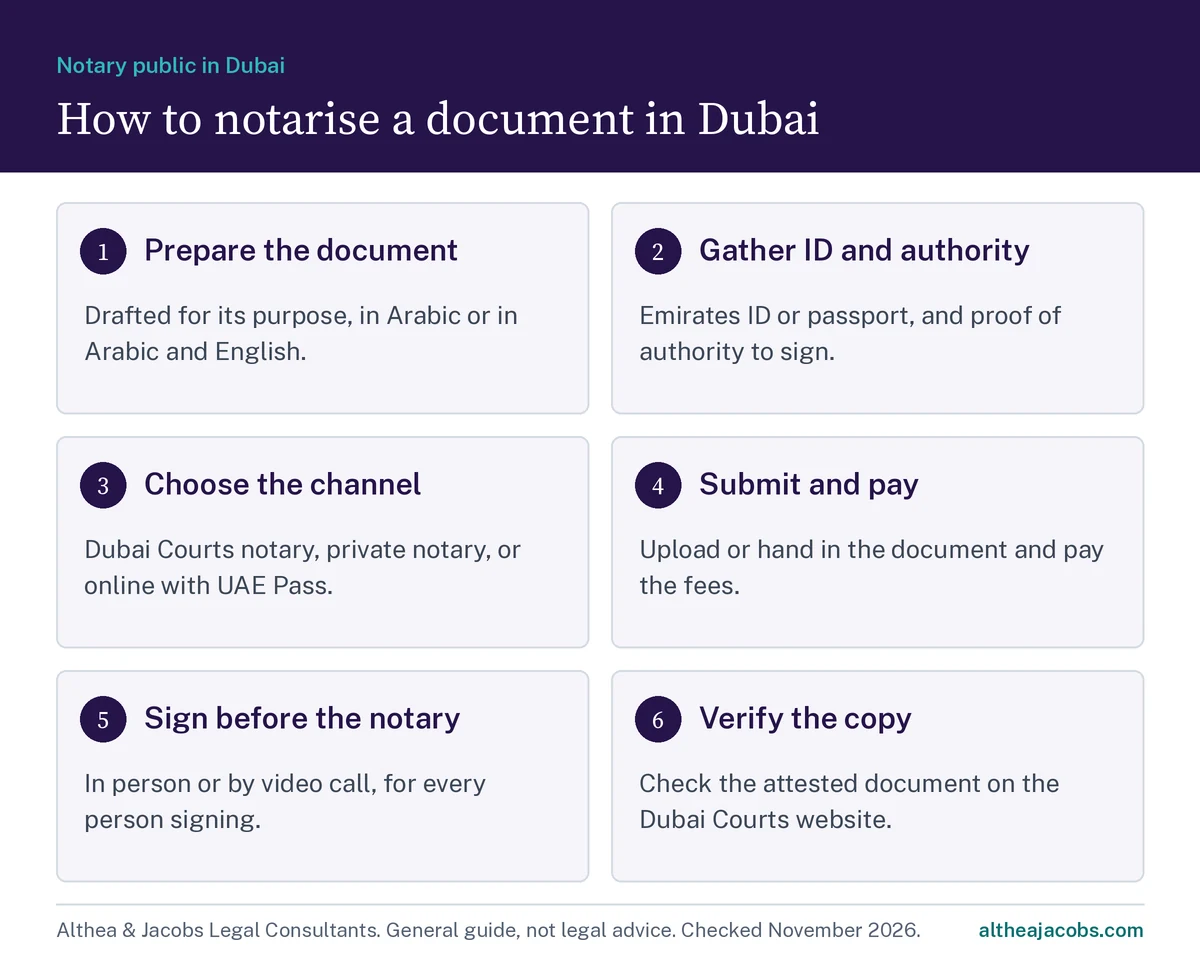
How to notarise a document in Dubai, step by step
- Prepare the document. Draft it for its exact purpose, in Arabic or in Arabic and English. If it is in another language, have it translated by a UAE-licensed legal translator.
- Gather what the notary will ask for. Original Emirates ID or passport for every signatory, and for a company the trade license, memorandum of association and proof of the signatory’s authority.
- Choose the channel. A Dubai Courts notary, a private notary or the electronic notary with UAE Pass.
- Submit and pay. Upload the document and details through the Dubai Courts website or app, or hand them to the private notary, and pay the fees.
- Sign before the notary. Every signatory attends in person or by video call. The notary checks identity and understanding, then attests the document.
- Receive and verify the attested copy. You receive the attested document, usually electronically, and it can be verified on the Dubai Courts website.
A straightforward document is often attested the same day. Delays usually come from the document itself: an unclear power of attorney, a missing translation or a signatory without proof of authority.
Notary public fees in Dubai
Government notary fees in Dubai are set by Executive Council Resolution No. 4 of 2014, as amended by Resolution No. 72 of 2025. The fees most people meet are:
| Service | Government fee |
|---|---|
| Attesting a power of attorney | AED 100 per signature attested |
| Entering the transaction data electronically | AED 100 per party |
| Attesting a legal notice | AED 200 |
| Attesting a translator’s signature | AED 25 per page of the original |
| Notary attending outside the office | AED 100 in limited cases, otherwise AED 1,000 |
Private notaries charge their own regulated fees on top. Under a Dubai Courts decision in force from 2 January 2026, these are AED 100 per party for registering the parties’ details, AED 100 per signature, and AED 1,000 if the notary travels outside their place of work. Legal translation and drafting are priced separately, so ask for the full figure before you book.
Documents from or for abroad
Notarisation is only one link in the chain when a document crosses borders. People often confuse three different steps:
- Notarisation confirms who signed. It is done by a notary where the document is signed.
- Legalisation confirms the notary’s seal. For a foreign document coming to the UAE, this is usually done by the UAE embassy or consulate in that country.
- Attestation by the UAE Ministry of Foreign Affairs confirms the legalisation so that UAE authorities will accept the document.
A power of attorney signed in another country, for example, normally needs notarising and legalising there, attestation by the Ministry of Foreign Affairs in the UAE and a legal translation into Arabic before a Dubai authority will accept it. A document notarised in Dubai for use abroad usually follows the same chain in reverse, so check what the receiving country requires before you start.
Common mistakes that get documents rejected
- Vague wording, especially in powers of attorney. The notary will not rewrite it, and an authority may refuse it later.
- The wrong signatory for a company, without proof in the memorandum of association or a board resolution that they can sign.
- Translations by unlicensed translators, or an English-only document where Arabic is required.
- Foreign documents that skipped a step in the legalisation and attestation chain.
- Assuming notarisation makes a document fair or enforceable. It proves the signature, not that the terms protect you.
When to involve a lawyer
You do not need a lawyer to visit a notary public in Dubai. A lawyer is worth it when the document carries real risk: a power of attorney over property or bank accounts, a memorandum of association or share transfer, a settlement agreement, or a notice that starts a dispute. Our corporate and commercial team drafts these documents in Arabic and English, arranges translation and notarisation, and works across the UAE and India. Speak to our corporate and commercial team before you sign anything important.
Frequently asked questions
How much does a notary public cost in Dubai?
Government fees are set by Executive Council Resolution No. 4 of 2014, as amended by Resolution No. 72 of 2025. Attesting a power of attorney costs AED 100 per signature, entering the transaction data costs AED 100 per party, and attesting a legal notice costs AED 200. Translation, drafting and any private notary charges are extra.
Can I notarise a document online in Dubai?
Yes. Residents with a UAE Pass can use the Dubai Courts electronic notary, upload the document, pay online and sign during a video call with the notary. Many routine documents, including most powers of attorney, can be completed this way.
Is a private notary in Dubai legal?
Yes. Private notaries are licensed and supervised by Dubai Courts under Law No. 4 of 2013, and their attestations have the same legal effect as those done at the courts. Since 2 January 2026 their own charges are regulated too.
Does a notary check whether my contract is fair?
No. A notary public confirms who signed, that they had capacity and that they signed willingly, and refuses documents that are clearly unlawful. The notary does not advise on whether the terms protect you, so have important documents reviewed before you sign.
Does my document need to be in Arabic?
Usually, yes. Documents notarised in Dubai are generally prepared in Arabic, or in Arabic and English side by side, with any translation done by a UAE-licensed legal translator.
I need a document for use abroad. Is notarisation enough?
Often not. Many countries also require attestation by the UAE Ministry of Foreign Affairs and legalisation by their embassy, unless another arrangement applies. Check what the receiving authority asks for before you book the notary.
Related guides: Power of attorney in Dubai: how to get one and the cost, Legal notice in the UAE: when to send one and Trade license renewal in Dubai.
Get your document drafted and notarised
Tell us what you need, in confidence. A lawyer will call you back within 24 hours with the documents required and a clear fee.
- 5.0 Google rating from 17 reviews
- Free first consultation
- Call back within 24 hours
“I really appreciate the honest advice and transparent pricing.”Sophia A., Google review
Office No. 18, 22nd Floor, Tower Plaza Hotel, Sheikh Zayed Road, Dubai. Monday to Friday, 9am to 6pm. The first consultation is free and confidential.
Request a call back
This guide is general information about UAE law and practice, not legal advice. Fees, procedures and online services change, so check the current position for your case or ask our team.
WhatsApp a lawyer