
Reviewed by Althea Edwina Rozario, Managing Partner, Althea & Jacobs Legal Consultants
Last updated
Choosing your trademark classes is one of the most important decisions in a UAE trademark application. Your registration only protects the goods and services in the classes you file, and each class adds government fees. File too narrowly and a competitor can register your name for related products; file too widely and you pay for protection you don’t need.
This guide explains the trademark classes used in the UAE, how to choose the right ones for your business, the classes that cause the most mistakes and what each class costs in 2026. For help with your own filing, our intellectual property lawyers in Dubai manage trademark portfolios across the UAE and the wider region.
The UAE uses the Nice Classification, which divides goods and services into 45 trademark classes: classes 1 to 34 for goods and 35 to 45 for services. Since 27 January 2026, new applications follow its 13th edition. To choose the right classes, list everything you sell and every service you provide, now and in the next few years, and match each one to its class. Fees are charged per class, so file in every class you actually use or plan to use, and no more.
Not sure which classes to file? The first consultation is free, and a lawyer calls back within 24 hours.
What trademark classes are
Trademark classes come from the Nice Classification, an international system administered by the World Intellectual Property Organization (WIPO) and used by most trademark offices in the world. Every product and service belongs to one of 45 classes, and a trademark is registered for specific goods and services within the classes chosen.
In the UAE, trademarks are governed by Federal Decree-Law No. 36 of 2021 on Trademarks and registered with the Ministry of Economy and Tourism. Under the Ministry’s Administrative Circular No. 1 of 2026, applications filed from 27 January 2026 must follow the 13th edition of the Nice Classification. Existing registrations are not cancelled because of the change.
The 13th edition moved some items between classes. The best-known change is that spectacles, sunglasses and contact lenses moved from class 9 to class 10, while smart glasses stay in class 9. If you are filing for products affected by these changes, check the current class before you file.
The 45 trademark classes
This trademark class list gives a short summary of each class. The official class headings are longer, and the full list of goods and services is published by WIPO.
| Class | What it covers |
|---|---|
| 1 | Chemicals for industry, science and agriculture, fertilisers, adhesives |
| 2 | Paints, varnishes, dyes, inks |
| 3 | Cosmetics, perfumes, skincare, cleaning preparations |
| 4 | Industrial oils, lubricants, fuels, candles |
| 5 | Pharmaceuticals, medical preparations, dietary supplements |
| 6 | Common metals, metal building materials, hardware |
| 7 | Machines, machine tools, motors and engines (not for land vehicles) |
| 8 | Hand tools, cutlery, razors |
| 9 | Computers, downloadable software and apps, electronics, recorded and downloadable media |
| 10 | Medical and dental apparatus; under the 13th edition, also spectacles, sunglasses and contact lenses |
| 11 | Lighting, heating, cooking, cooling and sanitary installations |
| 12 | Vehicles and parts of vehicles |
| 13 | Firearms, ammunition, fireworks |
| 14 | Jewellery, precious metals, watches |
| 15 | Musical instruments |
| 16 | Paper, printed matter, stationery, packaging materials |
| 17 | Rubber, plastics in semi-processed form, insulating materials |
| 18 | Leather goods, bags, luggage, umbrellas |
| 19 | Non-metallic building materials |
| 20 | Furniture, mirrors, frames |
| 21 | Household and kitchen utensils, glassware, porcelain |
| 22 | Ropes, tents, sacks, raw fibres |
| 23 | Yarns and threads for textile use |
| 24 | Textiles, bed and table linen |
| 25 | Clothing, footwear, headwear |
| 26 | Lace, ribbons, buttons, artificial flowers, hair accessories |
| 27 | Carpets, rugs, mats, wallpaper |
| 28 | Games, toys, sporting goods |
| 29 | Meat, fish, dairy, preserved fruit and vegetables, edible oils |
| 30 | Coffee, tea, bakery products, confectionery, rice, spices |
| 31 | Fresh produce, plants, seeds, animal food |
| 32 | Beers, soft drinks, mineral water, juices |
| 33 | Alcoholic beverages (except beers) |
| 34 | Tobacco, smokers’ articles, electronic cigarettes |
| 35 | Advertising, business management, office functions, retail and online store services |
| 36 | Financial, insurance, banking and real estate services |
| 37 | Construction, repair and installation services |
| 38 | Telecommunications |
| 39 | Transport, packaging and storage of goods, travel arrangement |
| 40 | Treatment of materials, custom manufacturing, printing |
| 41 | Education, training, entertainment, sporting and cultural activities |
| 42 | Scientific and technological services, software as a service, IT and design |
| 43 | Restaurants, cafés, catering, hotels and temporary accommodation |
| 44 | Medical, beauty, hygiene, veterinary and agricultural services |
| 45 | Legal services, security services, personal and social services |
How to choose your trademark classes
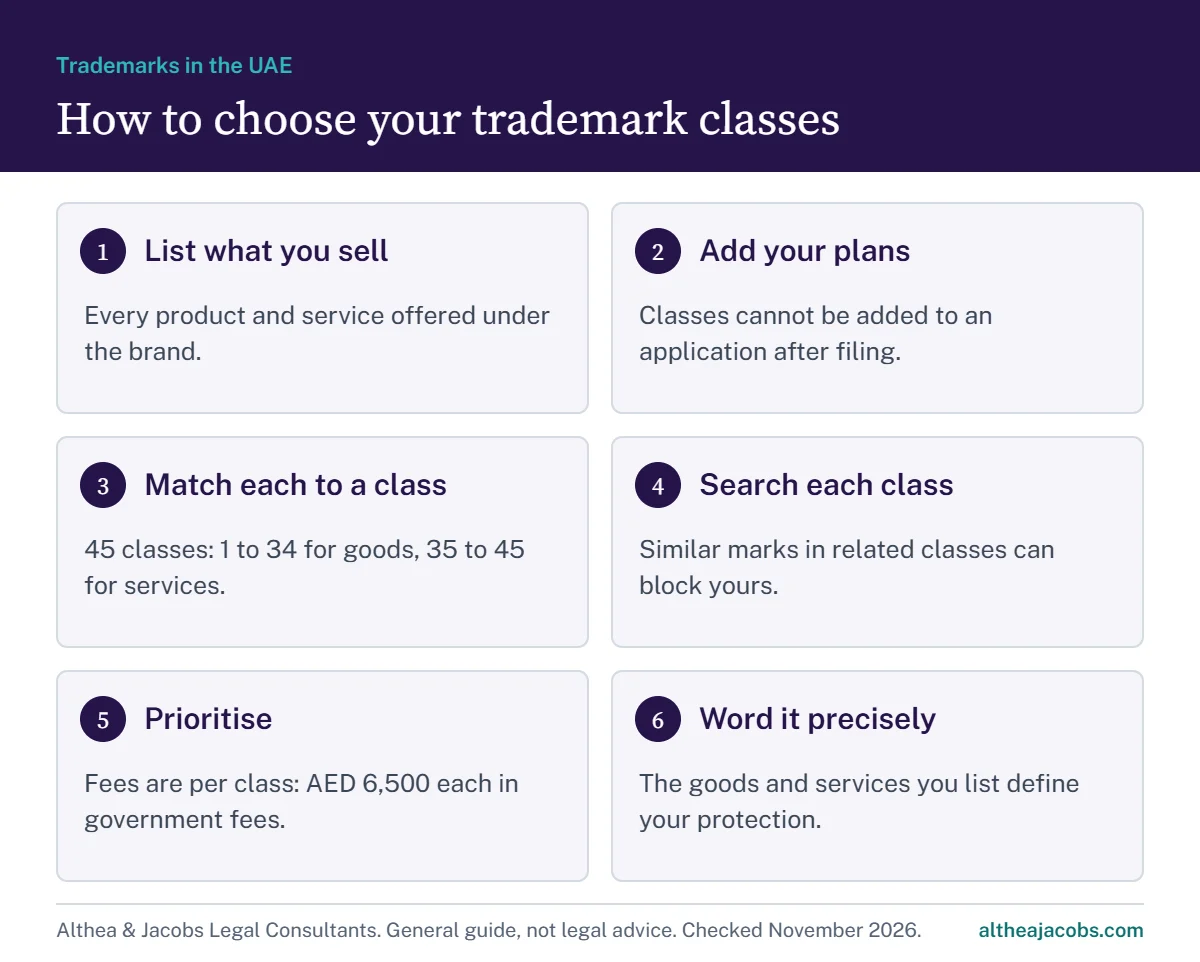
- List what you actually sell and do. Write down every product and every service offered under the brand, including services you provide to support your products.
- Add your plans for the next few years. If you will launch a product line or open a shop or café soon, include it now. Classes cannot be added to an application later.
- Match each item to its class. Use WIPO’s Nice Classification search to find the right class for each term. Goods and services related to them are often in different classes.
- Search the register in each class. A similar mark in a related class can block your application. Our guide to UAE trademark search explains how to check.
- Prioritise if the budget is tight. File first in the classes for your core products or services and the ones most exposed to copying, then add others in later applications.
- Write precise goods and services, not just the class number. The wording defines what you can enforce.
Class 35 explained
Class 35 is the class most often misunderstood. It covers advertising, marketing, business management and administration, office functions and retail and wholesale services, including online stores. It does not protect the goods you sell.
- A clothing brand needs class 25 for the clothes. Class 35 adds protection for the shop or online store, which matters if you sell other brands as well.
- A marketing or consultancy firm usually needs class 35 for its core services, and sometimes class 41 for training or class 42 for technology services.
- A marketplace or e-commerce platform usually needs class 35 for the retail service, class 9 for a downloadable app and class 42 for the online platform.
Classes that are often confused
| Business | Classes to consider |
|---|---|
| Mobile app or software company | 9 for downloadable software and apps, 42 for software as a service and IT services |
| Restaurant or café brand | 43 for restaurant services; 29, 30 or 32 if you sell packaged food or drinks under the brand |
| Cosmetics brand and beauty salon | 3 for the cosmetics, 44 for salon and beauty services, 35 for a shop |
| Fashion brand | 25 for clothing, 18 for bags, 14 for jewellery, 35 for the store |
| Real estate business | 36 for brokerage and property management, 37 for construction |
| Training or education provider | 41 for courses and training, 16 for printed materials, 9 for downloadable content |
| Eyewear brand | 10 for spectacles and sunglasses under the 13th edition (previously 9); 9 for smart glasses |
Writing the goods and services
The class number alone does not define your protection. The specification, meaning the list of goods and services you file, does. Use clear, recognised terms that describe what you actually offer, such as “skincare preparations” in class 3 rather than a vague phrase. A specification that is too broad can draw objections, and one that is too narrow may not cover the products a competitor launches.
Once an application is filed, you can narrow the goods and services but not widen them. That is why the wording deserves as much care as the choice of classes.
What each trademark class costs in the UAE
The Ministry of Economy and Tourism charges its fees per class. For a standard application, each class costs:
- Examination: AED 750.
- Publication: AED 750, paid after the application is accepted.
- Registration: AED 5,000, paid after the opposition period.
- Total government fees: AED 6,500 per class, with protection for 10 years.
- Renewal: AED 5,750 per class in the final year of protection.
So a mark filed in three classes costs about AED 19,500 in government fees. Our guide to trademark registration cost in the UAE covers the fast-track option, late payment fines and the full timeline.
Common mistakes
- Filing only in class 35 and assuming it protects your products.
- Missing the class for your app or software, or filing class 9 when the service is really in class 42.
- Forgetting future plans, then finding that someone else has registered the brand in that class.
- Copying class headings instead of describing your actual goods and services.
- Using an old edition of the classification for products that moved classes in 2026.
- Not searching related classes, where a similar mark can still block yours.
When to speak to a lawyer
A lawyer adds value when your business spans several products or services, when you sell online or through an app, when the brand is valuable to the business, or when a search shows similar marks. Our IP team chooses the classes and drafts the specification, runs the clearance search, files with the Ministry of Economy and Tourism and handles objections, oppositions and renewals. Speak to our intellectual property team in Dubai.
Frequently asked questions
How many trademark classes are there in the UAE?
There are 45 classes under the Nice Classification, which the UAE uses. Classes 1 to 34 cover goods and classes 35 to 45 cover services. Since 27 January 2026, new UAE applications follow the 13th edition of the classification.
Can I register one trademark in several classes in the UAE?
Yes, a mark can be protected in as many classes as your business needs, but the Ministry of Economy and Tourism charges the fees for each class. Protection only covers the goods and services in the classes you file, so list every class you use now or plan to use soon.
Which trademark class is for an online store?
Selling other people’s goods through a website or app is a retail service in class 35. If you sell products under your own brand, also file the classes for those products, for example class 25 for clothing or class 3 for cosmetics. If you offer the app or software itself, look at class 9 and class 42.
Which trademark class is for software and apps?
Downloadable software and mobile apps are in class 9. Software you provide online without the customer downloading it, such as software as a service or platform as a service, is in class 42. Many technology businesses file both.
How much does each trademark class cost in the UAE?
The official fees are charged per class: AED 750 for examination, AED 750 for publication and AED 5,000 for registration, so AED 6,500 per class in government fees for a standard application. Renewal after 10 years costs AED 5,750 per class. A lawyer’s or agent’s fee is extra.
Can I add a class after I file my trademark application?
No. You cannot add new classes, or widen the goods and services, after an application is filed. To cover a new class you need a new application, which gets a later filing date, so think about your plans before you file.
Related guides: Trademark symbol: TM vs ® in the UAE, Brand registration in the UAE, UAE trademark search and Trademark registration cost in the UAE.
Protect your brand in the right classes
Share your brand in confidence. A lawyer will call you back within 24 hours with the classes and filing plan that fit your business.
- 5.0 Google rating from 17 reviews
- Free first consultation
- Call back within 24 hours
“I really appreciate the honest advice and transparent pricing.”Sophia A., Google review
Office No. 18, 22nd Floor, Tower Plaza Hotel, Sheikh Zayed Road, Dubai. Monday to Friday, 9am to 6pm. The first consultation is free and confidential.
Request a call back
This guide is general information about UAE law and practice, not legal advice. Fees, procedures and online services change, so check the current position for your case or ask our team.
WhatsApp a lawyer