
By the Althea & Jacobs Legal Consultants team, Dubai
Last updated
The UAE Data Protection Law, known as the PDPL, is the federal law on how businesses collect, use, store and share personal data. It covers customer lists, employee files, CCTV footage, website forms, marketing databases and almost any other information about an identifiable person.
The law has been in force since January 2022, but its detailed rules and penalties are still waiting for implementing regulations. That leaves many businesses unsure what they must do now. This guide explains what the law requires, where things stand in November 2026, and a practical checklist to get ready. For advice on your own business, our corporate and commercial lawyers in Dubai help companies across the UAE and India put compliant data terms and policies in place.
The UAE Data Protection Law (Federal Decree-Law No. 45 of 2021) has applied since 2 January 2022 to businesses in the UAE and to businesses abroad that process the data of people in the UAE. It does not cover the DIFC or ADGM, which have their own laws. Businesses must have a legal basis for processing, usually clear consent; tell people how their data is used; respect their rights to access, correct and erase it; keep it secure; report breaches; and transfer it abroad only in permitted cases. The Executive Regulations and the penalty schedule had not been published at the time of writing, and businesses will have six months to comply once they are.
Want to know what the PDPL means for your business? The first consultation is free, and a lawyer calls back within 24 hours.
What the UAE Data Protection Law is and who it covers
The UAE Data Protection Law was issued as Federal Decree-Law No. 45 of 2021 on the Protection of Personal Data and came into force on 2 January 2022. It follows the same broad approach as the European GDPR, but it is not identical, so a GDPR policy copied word for word will not fit.
The law uses a few key terms:
- Personal data is any information that identifies a living person, directly or indirectly: a name, phone number, email address, ID number, photo, voice recording, location or online identifier.
- Sensitive personal data includes information about a person’s family, racial origin, political or philosophical opinions, religious beliefs, criminal record, biometric data and health. It needs extra care.
- The controller is the business that decides why and how data is processed, such as a company holding its customers’ details.
- The processor handles data on the controller’s behalf, such as a payroll provider, cloud host or marketing agency.
The PDPL applies to controllers and processors established in the UAE, whether the people whose data they handle are inside or outside the country. It also reaches businesses outside the UAE that process the personal data of people in the UAE, such as an overseas online shop selling to UAE customers.
Under Article 2, the law does not apply to:
- government data and government entities processing personal data;
- data held by security and judicial authorities;
- processing by individuals for purely personal purposes;
- health data and banking and credit data, where separate laws govern them;
- companies in free zones with their own data protection laws, mainly the DIFC and ADGM.
Where things stand in November 2026
This is the part that confuses most businesses. The UAE Data Protection Law is in force, but several pieces needed to apply it fully were still missing at the time of writing:
- The Executive Regulations have not been published. They were expected within six months of the law, but had still not appeared by mid-2026. They will fill in details such as breach notification deadlines and how some rights work.
- The compliance clock has not started. Businesses get six months from the date the Executive Regulations are issued to bring their processing into line, and the Cabinet can extend that period.
- There is no penalty schedule yet. The law leaves violations and administrative fines to a Cabinet decision, which has not been issued. Be wary of websites quoting specific PDPL fines; they are not in the law.
- The regulator is changing. The law created the UAE Data Office as regulator. In June 2026 the UAE approved a new Artificial Intelligence and Data Authority, reporting to the Cabinet, which absorbs the UAE Data Office. Its exact role in enforcing the PDPL is still to be confirmed.
None of this means the law can be ignored. It already sets the rules, other laws with real penalties apply to data misuse today, and six months is a short time to fix data practices once the regulations arrive. Large clients, banks and overseas partners also increasingly ask suppliers to show they comply.
Consent and the other legal bases for processing
The starting point under the UAE Data Protection Law is that personal data may only be processed with the person’s consent. To count, consent must be specific, clear and unambiguous, given by a positive act such as ticking an unticked box, and the person must be able to withdraw it as easily as they gave it. A pre-ticked box or a line buried in long terms and conditions is unlikely to be enough.
The law also allows processing without consent in set cases, including where it is needed to:
- perform a contract with the person, or take steps they asked for before entering into one;
- comply with a legal obligation on the business;
- protect the public interest;
- meet obligations under employment, social security or social protection law;
- establish, exercise or defend legal claims.
Unlike the GDPR, the PDPL has no general “legitimate interests” basis. In practice, this matters most for marketing: sending promotional messages usually needs consent, and people can object to direct marketing at any time.
People’s rights over their data
The PDPL gives individuals a set of rights that businesses must be ready to handle:
| Right | What it means for your business |
|---|---|
| Information and access | Tell people what data you hold about them, why, who receives it and how long you keep it, and give them a copy on request. |
| Correction and erasure | Correct inaccurate data, and delete data you no longer need or have no basis to keep. |
| Restriction | Pause processing in certain cases, for example while accuracy is disputed. |
| Portability | Provide the data in a structured, machine-readable format so it can be moved to another provider. |
| Objection | Stop processing for direct marketing on request, and in other cases set by the law. |
| Automated decisions | Let people object to decisions made solely by automated processing, including profiling, that significantly affect them. |
A simple internal procedure helps: one email address for data requests, a named person to handle them, a way to check the requester’s identity and a log of what was done.
Security, breaches and records
The UAE Data Protection Law also places practical duties on businesses that hold personal data:
- Keep data secure. Put appropriate technical and organisational measures in place, such as access controls, encryption, staff training and secure disposal.
- Report breaches (Article 9). A controller that becomes aware of a breach that could compromise people’s privacy must notify the regulator and the affected individuals. The deadlines will be set by the Executive Regulations, so have a breach plan ready now.
- Appoint a data protection officer where required (Article 10). This applies to high-risk processing using new technologies or large volumes of data, and to systematic or large-scale processing of sensitive data. The officer can be an employee or an outside provider.
- Assess high-risk processing (Article 21). Before high-risk processing using new technologies, carry out a data protection impact assessment.
- Keep a record of processing. Record what personal data you hold, why, who can access it and how it is modified or erased.
- Use written terms with processors. Suppliers that handle data for you should be bound by contract to protect it and to act only on your instructions.
Sending personal data outside the UAE
Many businesses store data on overseas cloud servers or share it with a parent company abroad. Under Articles 22 and 23 of the PDPL, personal data can be transferred outside the UAE:
- to countries whose data protection laws are considered adequate, or that have a data protection agreement with the UAE;
- or, where that is not the case, in set situations such as under a contract that requires the recipient to meet the standards of the PDPL, with the person’s express consent, to perform a contract with them, or for legal proceedings.
The list of adequate countries has not yet been published. Until it is, the safest route is a written data transfer agreement with the recipient. Health data has its own stricter rules under the law on information technology in the health sector (Federal Law No. 2 of 2019), which restricts storing and transferring health data outside the UAE.
Other UAE laws on data and privacy
While PDPL penalties wait for a Cabinet decision, other laws already protect personal data and privacy:
- The cybercrime law (Federal Decree-Law No. 34 of 2021) punishes unlawfully collecting or processing personal data, and Article 44 makes it a crime to invade someone’s private life using technology, for example by photographing, recording or publishing images of people without consent. Penalties include imprisonment and fines of up to AED 500,000. Our criminal defence lawyers in Dubai advise on these cases.
- The Child Digital Safety Law (Federal Decree-Law No. 26 of 2025) has been in force since 1 January 2026. It bars digital platforms from processing the data of children under 13 without verifiable parental consent and restricts targeted advertising to children. Platforms have until January 2027 to comply.
- Sector rules apply to banks, insurers, telecoms and healthcare providers, which often face stricter requirements from their own regulators.
- The DIFC and ADGM have their own data protection laws and regulators. DIFC fines run up to USD 100,000 per contravention, and ADGM fines can reach USD 28 million.
What businesses should do now
You do not need to wait for the Executive Regulations to start. A practical plan for most small and medium businesses looks like this:
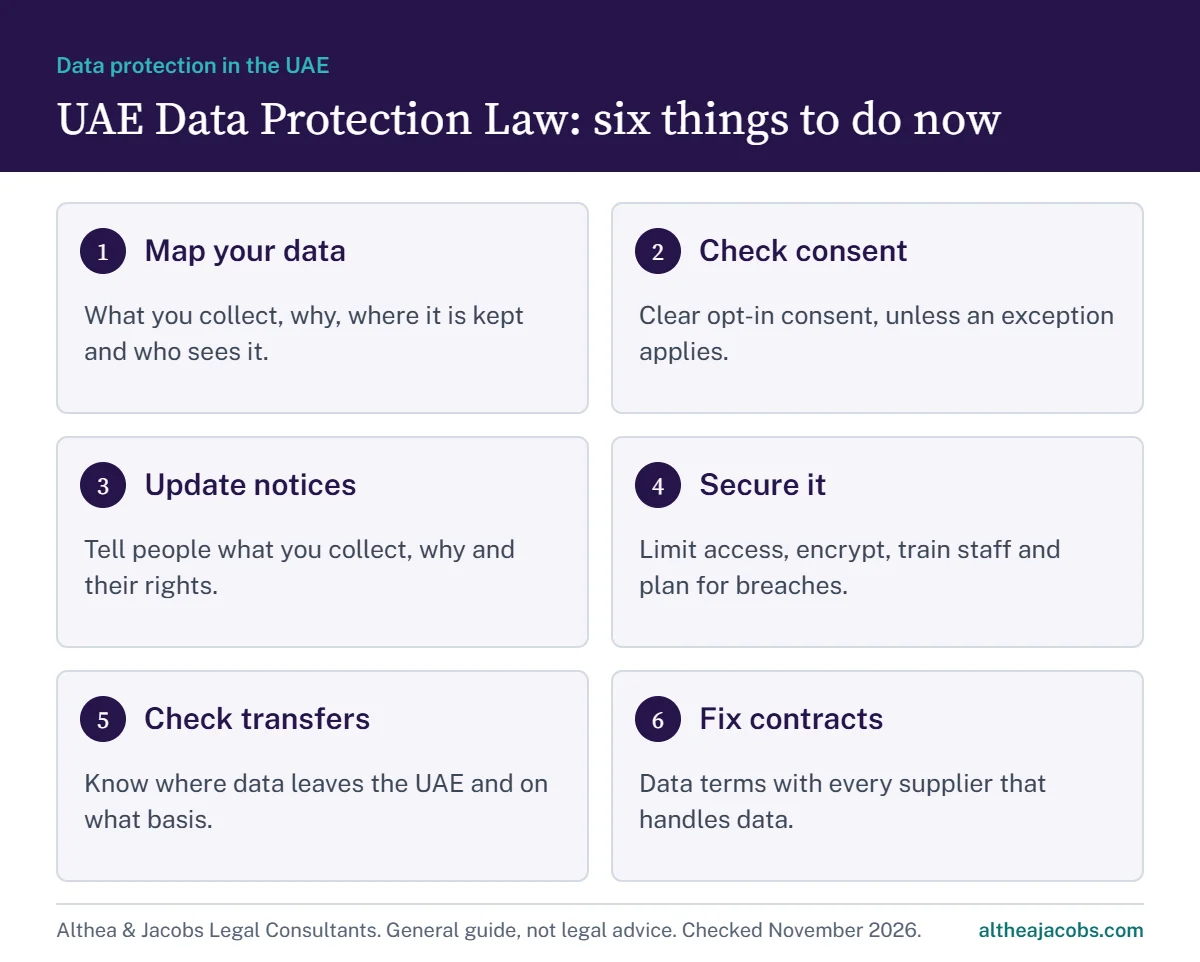
- Map your data. List what personal data you collect, from whom, why, where it is stored, who can see it and where it goes, including overseas.
- Check your legal basis. For each use, confirm whether you rely on consent or one of the exceptions. Fix pre-ticked boxes and vague consent wording.
- Update your privacy notice. Tell people in plain language what you collect, why, who receives it, how long you keep it and how to exercise their rights.
- Review supplier contracts. Add data protection terms to contracts with IT, payroll, cloud and marketing providers. Our guide to the new UAE Civil Transactions Law covers other changes to check when you update contracts.
- Secure the data and plan for breaches. Limit access, use strong passwords and encryption, train staff, and write down who does what if data is lost or leaked.
- Set up a request procedure. Decide how you will handle requests to access, correct or delete data.
- Clean up. Delete data you no longer need, including old CVs, former customers’ files and unused marketing lists.
- Watch for the regulations. Once the Executive Regulations are issued, the six-month countdown starts.
If you are setting up a new company, it is easier to build these steps in from day one. Our guide on how to start a business in Dubai covers the other legal basics.
When to speak to a lawyer
Legal advice is worth it when you handle sensitive data such as health or financial information, transfer data overseas, run marketing databases, use automated decision-making, or receive a data request, complaint or breach. Our corporate team drafts privacy notices, data processing and transfer agreements and internal policies, and reviews them again once the regulations are published. Speak to our corporate and commercial team in Dubai.
Frequently asked questions
Is there a data protection law in the UAE?
Yes. Federal Decree-Law No. 45 of 2021 on the Protection of Personal Data, known as the PDPL, came into force on 2 January 2022. It is the UAE’s first general federal data protection law and applies to most private businesses that handle personal data, apart from those in free zones with their own data protection laws, such as the DIFC and ADGM.
Does the UAE PDPL apply to companies outside the UAE?
It can. The law applies to businesses established in the UAE, whether the people whose data they handle are inside or outside the country, and also to businesses outside the UAE that process the personal data of people in the UAE.
Does the PDPL apply in the DIFC and ADGM?
No. The DIFC has its own Data Protection Law (DIFC Law No. 5 of 2020) and the ADGM has its own Data Protection Regulations 2021, each with its own regulator and fines. Companies in other free zones and on the mainland are generally covered by the federal PDPL.
What are the fines under the UAE data protection law?
The PDPL itself does not set fine amounts. It leaves violations and administrative penalties to a Cabinet decision, and no penalty schedule had been published at the time of writing (November 2026). Other laws already apply, though: for example, the cybercrime law punishes unlawfully collecting or processing personal data and invading privacy with fines and imprisonment.
Does my business need a data protection officer in the UAE?
Only in certain cases. Under Article 10 of the PDPL, a data protection officer is required where processing poses a high risk because of new technology or the volume of data, or involves systematic assessment or large volumes of sensitive personal data, such as health, biometric or criminal records data. The officer can be an employee or an outside provider.
When do businesses have to comply with the PDPL?
The law has been in force since 2 January 2022, but businesses get six months to comply from the date the Executive Regulations are issued, and the Cabinet can extend that. The regulations had not been published at the time of writing. Six months is a short time to fix data practices, so most businesses are better off preparing now.
Related guides: New UAE Civil Transactions Law: what changes for contracts, How to start a business in Dubai and Mainland vs free zone company in Dubai.
Make your business ready for the PDPL
Tell us how your business collects and uses personal data. A lawyer will call you back within 24 hours with the steps that matter most.
- 5.0 Google rating from 17 reviews
- Free first consultation
- Call back within 24 hours
“I really appreciate the honest advice and transparent pricing.”Sophia A., Google review
Office No. 18, 22nd Floor, Tower Plaza Hotel, Sheikh Zayed Road, Dubai. Monday to Friday, 9am to 6pm. The first consultation is free and confidential.
Request a call back
This guide is general information about UAE law and practice, not legal advice. Fees, procedures and online services change, so check the current position for your case or ask our team.
WhatsApp a lawyer