

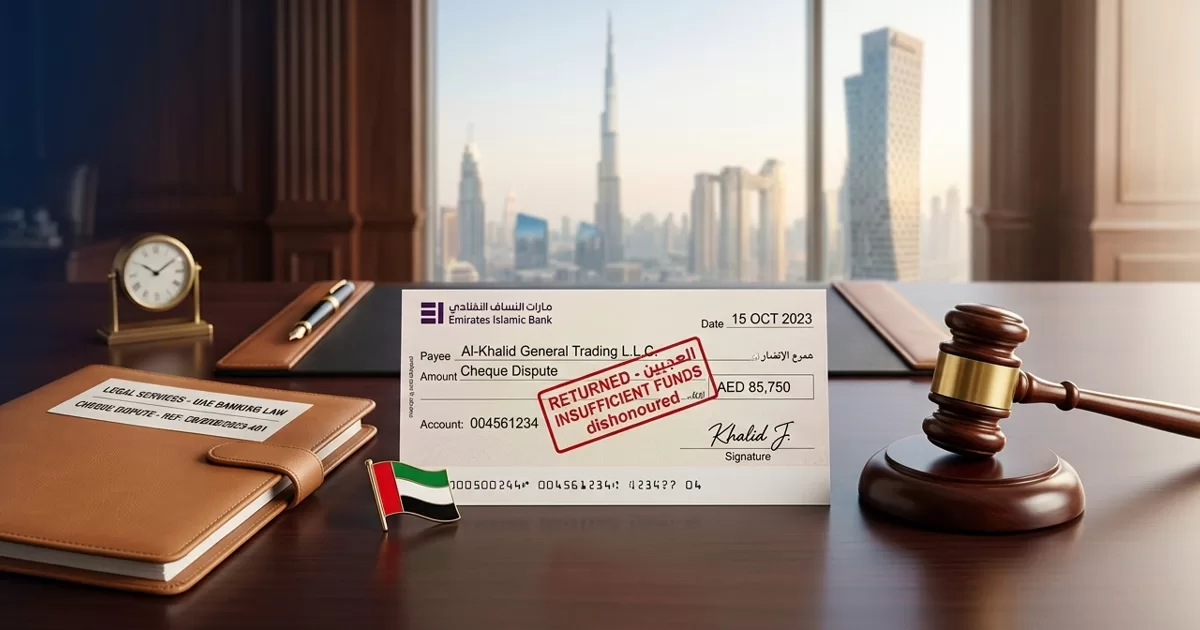
Banking lawyers in Dubai are seeing a sharp rise in cheque bounce queries following the UAE’s landmark legal reforms. If you have received or issued a dishonoured cheque, understanding the updated rules is critical. The UAE has shifted from a purely criminal approach to a more balanced framework that includes civil remedies and structured settlement options. This blog breaks down everything businesses and individuals need to know about cheque bounce cases under the latest UAE laws.
Key Takeaways
- Banking lawyers in Dubai confirm the UAE decriminalised certain cheque bounce offences, introducing civil enforcement through execution courts as the primary remedy for most dishonoured cheque disputes.
- Criminal liability still applies in specific circumstances, including fraud, forgery, and wilful dishonesty in issuing cheques, so early legal advice from a banking law firm UAE remains essential.
- Structured settlement procedures and partial payment orders make proactive legal engagement more important than ever for both cheque holders and drawers.
How UAE Cheque Bounce Laws Have Changed
The UAE introduced critical reforms to cheque laws through amendments to Federal Decree Law No. 14 of 2020, which took effect in January 2022. For decades, issuing a bad cheque was treated as a criminal offence almost automatically. The reform changed this significantly.
Under the updated framework, the UAE Ministry of Justice allows the cheque holder to obtain a direct execution order from the court without filing a criminal case. This means the holder can enforce payment more quickly without navigating lengthy criminal proceedings.
The reforms also introduced partial payment. If a bank account has insufficient funds but holds some balance, the bank must pay the available amount. The cheque holder can then seek the remainder through civil enforcement. Banking and insurance legal services at Althea and Jacobs provide guidance on how to use these new mechanisms effectively.
Criminal Liability: When Does It Still Apply?
A common misconception is that cheque bounce is no longer a criminal matter in the UAE. That is not entirely accurate. Banking lawyers UAE clarify that criminal liability has been narrowed, not eliminated.
Criminal charges can still be filed in cases involving:
- Fraud or deliberate deception in issuing a cheque
- Forgery of a cheque or related documents
- Closing a bank account after issuing a cheque with knowledge of the closure
- Instructing the bank to stop payment without a legitimate legal reason
- Repeated dishonoured cheques indicating wilful default
In these scenarios, the offence carries penalties including fines and potential imprisonment. A qualified banking law firm UAE can assess whether your situation meets the threshold for criminal prosecution or whether civil action is the more appropriate route.
Civil Enforcement and Debt Recovery Options
For many cheque bounce cases, the most effective remedy is now civil enforcement. This shift benefits creditors who want faster resolution without the complexities of criminal court.
Under the reformed law, the cheque holder can apply directly to the execution court to obtain a payment order. The court can then enforce this against the debtor’s assets. This process is generally faster and more targeted than criminal proceedings.
Banking legal services UAE practitioners at firms like Althea and Jacobs handle these execution applications regularly. Key steps include:
- Presenting the original dishonoured cheque and the bank’s return notice to the court
- Filing an application for an execution order
- Receiving a court order compelling payment, often within a defined timeframe
- Enforcing against the debtor’s bank accounts, salary, or property if payment is not made voluntarily
For businesses dealing with unpaid cheques from clients or counterparties, this civil route can be a powerful debt recovery tool. You can read more about how this connects to broader corporate and commercial legal strategies in the UAE.
Settlement Procedures and Out-of-Court Resolutions
The UAE reforms also introduced structured settlement procedures designed to encourage early resolution. Banking lawyers in Dubai often advise clients to explore settlement before pursuing formal enforcement, particularly where there is an ongoing commercial relationship.
A cheque drawer who acknowledges the debt can negotiate a payment plan or lump-sum settlement directly with the holder. Once a settlement agreement is reached and documented, it can be filed with the court for enforcement if the terms are later breached.
Key benefits of settlement include:
- Avoiding the costs and delays of full litigation
- Preserving business relationships where possible
- Faster access to funds through agreed payment schedules
- Reducing the risk of the debtor declaring insolvency before enforcement
Settlement discussions are most productive when a banking lawyers UAE professional is involved early. Legal representation ensures the agreement is properly documented and enforceable, protecting both parties.
Practical Guidance for Businesses and Individuals
Whether you are a business dealing with a supplier’s bounced cheque or an individual facing a claim after a dishonoured payment, the updated UAE framework provides clearer options than before.
For cheque holders, the priority is acting quickly. The revised law sets specific timeframes for filing execution applications. Missing these windows can limit your legal options. Consulting banking lawyers in Dubai promptly after a cheque is dishonoured is strongly recommended.
For cheque drawers, proactive communication is important. Reaching out to the holder to explain the situation and propose a resolution before formal proceedings begin can significantly reduce legal exposure. Courts look more favourably on parties who demonstrate good faith efforts to resolve the matter.
Businesses operating in the UAE should also review their internal cheque acceptance policies. Verifying a counterparty’s financial standing before accepting post-dated cheques, and using formal payment agreements, reduces the risk of disputes. For broader compliance guidance, exploring the UAE legal updates for 2026 is a useful starting point.
Additionally, companies dealing with cheque-related disputes that intersect with employment issues, such as unpaid salary cheques, should understand how these overlap with employee rights under UAE employment law.
Conclusion
Cheque bounce laws in the UAE have undergone a meaningful transformation. The shift from automatic criminal prosecution to a flexible framework combining civil enforcement, structured settlement, and targeted criminal liability reflects the UAE’s commitment to a business-friendly legal environment. However, the rules are detailed and time-sensitive. Whether you need to recover funds or defend a claim, working with experienced banking lawyers in Dubai ensures your rights are protected at every stage. Reach out to the banking and insurance legal team at Althea and Jacobs to get personalised advice on your cheque dispute today.