

Reviewed by Althea Edwina Rozario, Managing Partner, Althea & Jacobs Legal Consultants
Last updated
A renewal notice arrives with a higher figure, and the question is always the same: can the landlord really ask for that? A Dubai rent increase is not a matter of negotiation alone. The law sets when rent can go up, how much notice you must get and the maximum percentage, and an official calculator tells you the answer for your own building.
This guide explains the rules for landlords and tenants, how to check an increase with the Dubai Land Department’s Smart Rental Index, and what to do when the figure is higher than the law allows. If talking it through fails, our litigation lawyers in Dubai handle Rental Dispute Centre cases directly for both tenants and landlords.
A landlord in Dubai can raise the rent only when the lease is renewed, with written notice at least 90 days before it expires, and only by the percentage Decree No. 43 of 2013 allows. There is no increase if your rent is no more than 10% below the average for similar units on the Dubai Land Department’s Smart Rental Index, rising in steps to a maximum of 20% if it is more than 40% below. If the landlord asks for more, the Rental Dispute Centre decides.
Received a rent increase notice? The first consultation is free, and a lawyer calls back within 24 hours.
When can a landlord increase the rent in Dubai?
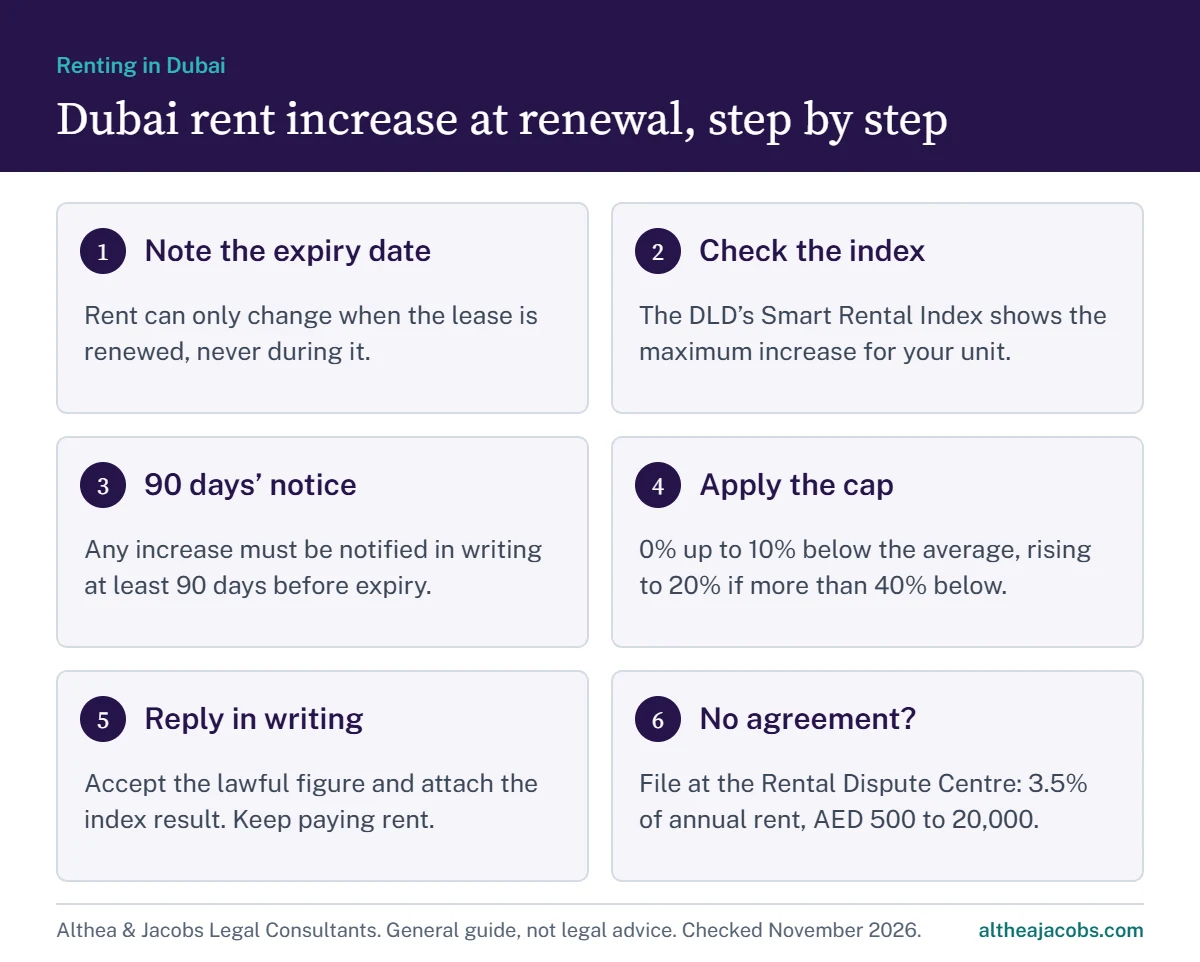
Rent in Dubai is set by the lease and stays fixed for its term. Under Article 13 of Law No. 26 of 2007, as amended by Law No. 33 of 2008, the landlord and tenant can revisit the rent, up or down, only when the contract is renewed. Three conditions apply to any increase:
- It happens at renewal, never part way through the contract.
- It is notified in writing at least 90 days before the lease expires (Article 14), unless the contract sets a different period.
- It stays within the cap set by Decree No. 43 of 2013, measured against the official rental index.
Decree No. 43 of 2013 applies to all landlords in Dubai, public and private, including in the special development zones and free zones. The old rule that froze rent for the first two years of a lease was removed in 2008, so a landlord can ask for an increase at the first renewal if the index allows it.
Rent increase limits in Dubai: how much can rent go up?
Article 1 of Decree No. 43 of 2013 compares your current rent with the average rent for similar units, as shown on the rental index approved by the Real Estate Regulatory Agency (RERA). The further your rent is below that average, the more it can rise:
| Your current rent compared with the index average | Maximum Dubai rent increase |
|---|---|
| Up to 10% below the average | No increase |
| 11% to 20% below | 5% of your current rent |
| 21% to 30% below | 10% |
| 31% to 40% below | 15% |
| More than 40% below | 20% |
For example, if you pay AED 80,000 a year and the index average for similar units is AED 100,000, your rent is 20% below the average. The maximum increase is 5%, or AED 4,000, so the most the landlord can ask is AED 84,000. If your rent is already above the average, no increase is allowed at all.
These are maximums. A landlord can ask for less, or nothing, and many do to keep a reliable tenant.
How to check your rent increase with the RERA rent calculator
The calculator most people call the RERA rent calculator is the Dubai Land Department’s Smart Rental Index, launched on 2 January 2025. It covers all residential areas of Dubai, including special development zones and free zones, and compares your unit with similar ones in the same building and area rather than a whole district. It looks at the building’s construction, finish and maintenance, location and services.
- Open the Rental Index service on the Dubai Land Department website (dubailand.gov.ae) or in the Dubai REST app.
- Enter your details: the property type, your Ejari number, the contract end date and your current annual rent.
- Read the result. It shows the average rent for similar units and the maximum increase allowed at your renewal.
- Save a copy as a PDF or screenshot, with the date. It is the evidence you will rely on with your landlord and, if needed, at the Rental Dispute Centre.
For a quick estimate first, our RERA rent increase calculator applies the Decree No. 43 of 2013 limits to your current rent and the index average. The official Smart Rental Index result is still the one that counts with your landlord and at the Rental Dispute Centre.
The 90-day notice rule for a rent increase
Article 14 of the tenancy law requires the party who wants to change the lease terms, including the rent, to tell the other at least 90 days before the contract expires. If the landlord misses that deadline, the Rental Dispute Centre has generally held that the rent increase can’t be imposed for that renewal, and the lease renews on the same terms. You can still agree to a change if you want to.
Notice must be in writing, and the law accepts notice through a notary public, by registered post, by hand or by approved electronic means. Whichever route is used, keep proof of the date it was sent and received. Our guide to legal notices in the UAE explains when a notarised notice is worth the extra step.
What to do if the rent increase is too high
- Check the index for your unit and save the result.
- Reply in writing before the lease expires. Accept the lawful amount, refuse the excess, refer to Decree No. 43 of 2013 and attach the index result.
- Negotiate. Many landlords accept the index figure once they see it in writing.
- Keep paying the rent. Stopping payment gives the landlord a ground for eviction. If the landlord refuses to accept your rent, ask whether it can be deposited with the Rental Dispute Centre.
- File at the Rental Dispute Centre if there is no agreement. The fee for a rental claim is 3.5% of the annual rent, with a minimum of AED 500 and a maximum of AED 20,000. The Centre tries to settle the dispute first, and its judges apply the index.
A landlord can’t evict you simply for refusing an increase the index doesn’t allow. Eviction at the end of a lease is only possible on the grounds in Article 25 of the tenancy law, such as sale, personal use or major works, and needs 12 months’ notice through a notary public or registered mail. Our guide to filing a rental dispute in Dubai explains the Rental Dispute Centre process step by step.
For landlords: how to raise rent lawfully
A Dubai rent increase that follows the rules is hard to challenge. Before you send the notice, check the index for the unit, work out the maximum increase, and send written notice comfortably more than 90 days before expiry with the index result attached.
If you believe the index does not reflect your property, the Dubai Land Department’s rental valuation service gives an official valuation of a specific unit, for AED 2,000 per unit (capped at AED 10,000) plus AED 20 in knowledge and innovation fees. It is mainly used for vacant units and where a valuation is ordered in a dispute. For the renewal of an occupied unit, the index and Decree No. 43 of 2013 still set the cap, so take advice before relying on a valuation alone.
If the tenant refuses a lawful increase, you can file a claim at the Rental Dispute Centre, which can set a fair rent under Article 13 of the tenancy law.
Common mistakes
- Signing first and complaining later. Once you sign and register a renewal at the higher rent, it is much harder to challenge.
- Relying on listings or a neighbour’s rent instead of the official index result for your unit.
- Giving or accepting notice by phone call or WhatsApp alone, with no proof of the date.
- Missing the 90-day deadline, for landlords, by counting from the wrong expiry date.
- Stopping rent payments during the disagreement.
Frequently asked questions
Can my landlord increase the rent every year in Dubai?
Yes, at each renewal, but only within the limits of Decree No. 43 of 2013 and only with written notice at least 90 days before the lease expires. If your rent is already close to the Smart Rental Index average for similar units, no increase is allowed that year.
Can a landlord increase the rent during the contract?
No. The rent is fixed for the term of the lease. Under Article 13 of Law No. 26 of 2007, as amended, the landlord and tenant can only revisit the rent when the contract is renewed.
What if my landlord didn’t give 90 days’ notice?
Then the increase can’t be imposed for that renewal. Article 14 requires notice of any change to the terms at least 90 days before expiry, and the Rental Dispute Centre has generally held that, without it, the lease renews on the same terms. You can still agree to a change voluntarily.
Can I be evicted for refusing a rent increase?
Refusing an increase that the index doesn’t allow is not a ground for eviction. Eviction at the end of a lease is only possible on the grounds in Article 25 of the tenancy law, such as sale, personal use or major works, with 12 months’ notice through a notary public or registered mail.
Does the rent increase calculator apply to offices and shops?
Decree No. 43 of 2013 covers all real property in Dubai, including commercial units. The Smart Rental Index currently covers residential buildings, and the Dubai Land Department has said commercial and industrial indexes will follow, so check the DLD’s current index service for your unit or ask us.
Has Dubai frozen rent increases like Abu Dhabi?
No. Abu Dhabi suspended rent increases from 2 June 2026, but that applies only in Abu Dhabi. In Dubai, the percentage bands in Decree No. 43 of 2013 and the Smart Rental Index still decide how much rent can go up at renewal.
Related guides: Eviction notice in Dubai: can your landlord make you leave?, Rental dispute in Dubai: how to file a case at the RDC and Legal notice in the UAE: when to send one.
Speak to a lawyer about your rent increase
Share the notice and your contract in confidence. A lawyer will call you back within 24 hours with a clear view of your options.
- 5.0 Google rating from 17 reviews
- Free first consultation
- Call back within 24 hours
“I really appreciate the honest advice and transparent pricing.”Sophia A., Google review
Office No. 18, 22nd Floor, Tower Plaza Hotel, Sheikh Zayed Road, Dubai. Monday to Friday, 9am to 6pm. The first consultation is free and confidential.
Request a call back
This guide is general information about UAE law and practice, not legal advice. Fees, procedures and online services change, so check the current position for your case or ask our team.
WhatsApp a lawyer