
Reviewed by Althea Edwina Rozario, Managing Partner, Althea & Jacobs Legal Consultants
Last updated
Mainland vs free zone is the first big decision when you set up a company in Dubai, and it shapes who you can sell to, where you can work, how many visas you get and how you are taxed. The rules have changed in the last few years, so advice that was right in 2020 may be out of date.
This guide compares a mainland company with a free zone company under the 2026 rules, including the 2025 resolution that lets Dubai free zone companies work on the mainland. For advice on your own structure, our corporate and commercial lawyers in Dubai set up and restructure companies every week.
A mainland company in Dubai is licensed by the Department of Economy and Tourism and can trade anywhere in the UAE, including with government entities, and most activities now allow 100% foreign ownership. A free zone company is licensed by a free zone authority, also with 100% foreign ownership, and can trade inside its zone and abroad, and on the Dubai mainland only with a branch licence or temporary permit under Executive Council Resolution No. 11 of 2025. Choose mainland if your customers are mainly in the UAE, and a free zone if they are mainly abroad or you need the 0% corporate tax rate on qualifying income.
Not sure which to choose? The first consultation is free, and a lawyer calls back within 24 hours.
Mainland vs free zone company at a glance
| Mainland company | Free zone company | |
|---|---|---|
| Licensed by | Department of Economy and Tourism (DET) | The free zone authority, such as DMCC, IFZA or DIFC |
| Foreign ownership | Up to 100% for most activities | 100% |
| Where you can trade | Anywhere in the UAE and abroad | Inside the zone and abroad; Dubai mainland with a DET permit |
| Government contracts | Yes | Usually through a mainland entity or partner |
| Corporate tax | 9% above AED 375,000 of taxable income | 0% on qualifying income if a Qualifying Free Zone Person, 9% on the rest |
| Office | A physical office with Ejari | Flexi-desk to full office, depending on the zone |
| Visas | Linked to office size | Linked to the package and office |
| Courts | Onshore UAE courts | Onshore courts, or DIFC and ADGM courts for those zones |
Ownership
Until 2021, most mainland companies needed an Emirati shareholder holding 51%. Federal Decree-Law No. 26 of 2020, now consolidated in the Commercial Companies Law, Federal Decree-Law No. 32 of 2021, removed that rule for most activities. Today a foreign investor can usually own 100% of a mainland limited liability company.
A small number of activities with strategic impact still have ownership or approval conditions. Professional firms can also choose a professional licence, which may need a local service agent. Check the activity list before you sign anything.
Mainland vs free zone: where you can trade
A mainland company can sell to customers anywhere in the UAE, open shops and branches in the city and bid for government contracts. A free zone company has traditionally been limited to its zone and to customers abroad, and had to use a distributor or open a mainland branch to sell onshore.
That changed with Dubai Executive Council Resolution No. 11 of 2025. A Dubai free zone company, except DIFC financial institutions, can now operate on the Dubai mainland with either a branch licence or a temporary permit from DET. It must keep separate financial records for the mainland work, and companies already working on the mainland had one year from March 2025 to regularise. The resolution covers Dubai only; other emirates have their own rules.
Corporate tax
Both mainland and free zone companies are within UAE corporate tax under Federal Decree-Law No. 47 of 2022, and both must register with the Federal Tax Authority.
- Mainland: 0% on taxable income up to AED 375,000 and 9% above it.
- Free zone: a Qualifying Free Zone Person pays 0% on qualifying income and 9% on other income. It must keep adequate substance in the zone, prepare audited accounts and meet the de minimis test, which allows non-qualifying revenue of up to 5% of total revenue or AED 5 million, whichever is lower.
- Mainland branch of a free zone company: income earned through the branch is taxed at 9%.
- Small Business Relief: resident businesses with revenue of AED 3 million or less can elect relief for tax periods ending on or before 31 December 2029.
A free zone company that loses qualifying status falls into the 9% regime, so the 0% rate needs planning, not just a free zone address.
Office space and visas
A mainland company needs a physical office with a registered tenancy contract (Ejari), and the number of visas usually depends on the office size. Free zones offer more flexible options, from a shared desk to a full office, with visa quotas tied to the package. If you need many visas, compare the real office cost of each option, not just the licence fee.
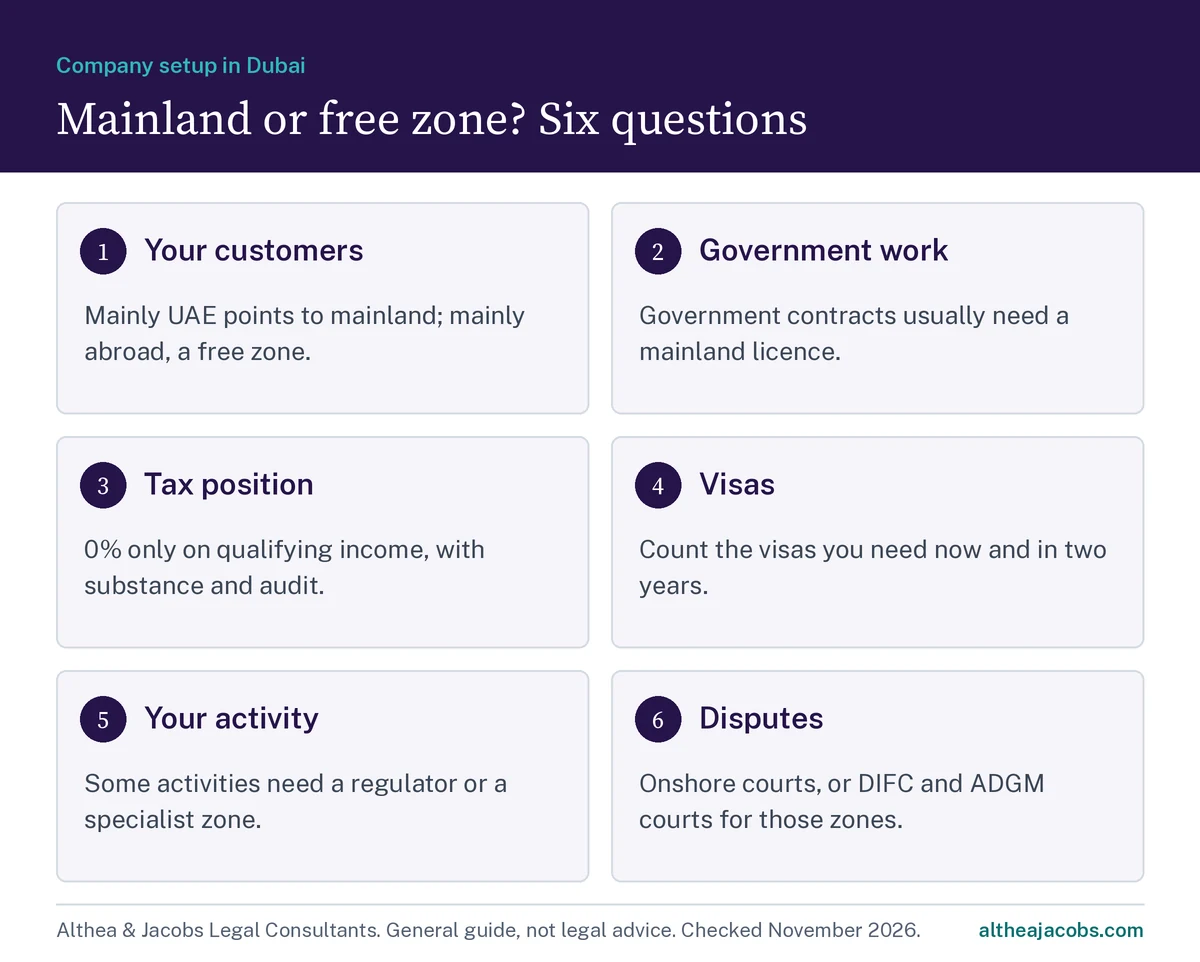
How to choose: six questions
Whether you are planning mainland company formation in Dubai or free zone company formation in Dubai, these questions usually decide it.
- Who are your customers? Mainly in the UAE points to mainland; mainly abroad points to a free zone.
- Do you need government contracts or a shop or office in the city? Mainland is usually needed.
- Can you use the 0% rate? Only if your income is qualifying income and you can meet the substance and audit conditions.
- How many visas do you need, now and in two years?
- Does your activity need a regulator, such as a financial or healthcare licence? Some zones specialise.
- Where would disputes be heard? DIFC and ADGM have their own common law courts; elsewhere disputes go to the onshore courts.
Common mistakes
- Choosing on the first-year price without checking renewal, office and visa costs.
- Assuming free zone means 0% tax on all income.
- Trading on the mainland without a permit after setting up in a free zone.
- Picking the wrong activity, which can block the work you actually want to do.
- Skipping the shareholder agreement and memorandum of association details when there is more than one owner.
When to speak to a lawyer
A lawyer adds value when there are several shareholders, when you plan to sell to UAE customers from a free zone, when tax status matters, or when you are moving an existing business between structures. Our corporate team advises on the structure, prepares the memorandum of association and shareholder agreements, and handles licensing and renewals. If you already have a company, our guide to trade license renewal in Dubai covers the yearly steps. Speak to our corporate team in Dubai.
Frequently asked questions
Can a foreigner own 100% of a mainland company in Dubai?
Yes, for most activities. Since the 2021 changes to the Commercial Companies Law, foreign investors can own 100% of a mainland company without an Emirati partner. A short list of strategic activities still has ownership conditions, so check your activity before you apply.
Can a free zone company do business on the Dubai mainland?
Yes, with a permit. Under Dubai Executive Council Resolution No. 11 of 2025, a free zone company, except DIFC financial institutions, can operate on the Dubai mainland if it gets a branch licence or a temporary permit from the Department of Economy and Tourism, and keeps separate accounts for the mainland business.
Do free zone companies pay corporate tax?
Free zone companies are within the corporate tax system. A Qualifying Free Zone Person pays 0% on qualifying income and 9% on other income, provided it meets conditions such as adequate substance, audited accounts and the de minimis test. Income earned through a mainland branch is taxed at 9%.
Is a mainland company more expensive than a free zone company?
Not always. Mainland costs depend on the activity, office lease and visas, and free zone packages vary widely between zones. Compare quotes that list the licence, registration, office and visa costs, and the yearly renewal, not just the first-year price.
Which is better for e-commerce or consultancy?
It depends on your customers. If you mainly sell abroad or online, a free zone is often enough. If you will sign contracts with UAE companies or government entities, or need a shop or office in the city, a mainland licence is usually the better fit.
Can I switch from free zone to mainland later?
Yes. You can open a mainland branch, set up a separate mainland company or, in some cases, transfer the company. Each route has different tax, visa and contract consequences, so take advice before moving.
Related guides: Offshore company in the UAE, Business setup cost in Dubai 2026, How to start a business in Dubai: a lawyer’s guide, Trade license in Dubai: types, rules and how to apply, Trade license renewal in Dubai: steps, fees and fines and Brand registration in the UAE: register your name and logo.
Set up the right company in Dubai
Share your plans in confidence. A lawyer will call you back within 24 hours with the structure that fits.
- 5.0 Google rating from 17 reviews
- Free first consultation
- Call back within 24 hours
“I really appreciate the honest advice and transparent pricing.”Sophia A., Google review
Office No. 18, 22nd Floor, Tower Plaza Hotel, Sheikh Zayed Road, Dubai. Monday to Friday, 9am to 6pm. The first consultation is free and confidential.
Request a call back
This guide is general information about UAE law and practice, not legal advice. Fees, procedures and online services change, so check the current position for your case or ask our team.
WhatsApp a lawyer