
By the Althea & Jacobs Legal Consultants team, Dubai
Last updated
An offshore company in the UAE is often sold as a cheap, private, tax-free structure. The reality in 2026 is more specific. Offshore companies are useful tools for holding property, shares and intellectual property, but they cannot trade in the UAE, they do not come with visas, and they now sit inside the UAE corporate tax system.
This guide explains what a UAE offshore company is, which registries offer one, what it can and cannot do, the tax position and the costs, so you can decide whether it suits your plans. For advice on structuring your business or assets, our corporate and commercial lawyers in Dubai advise founders, families and investors across the UAE and India.
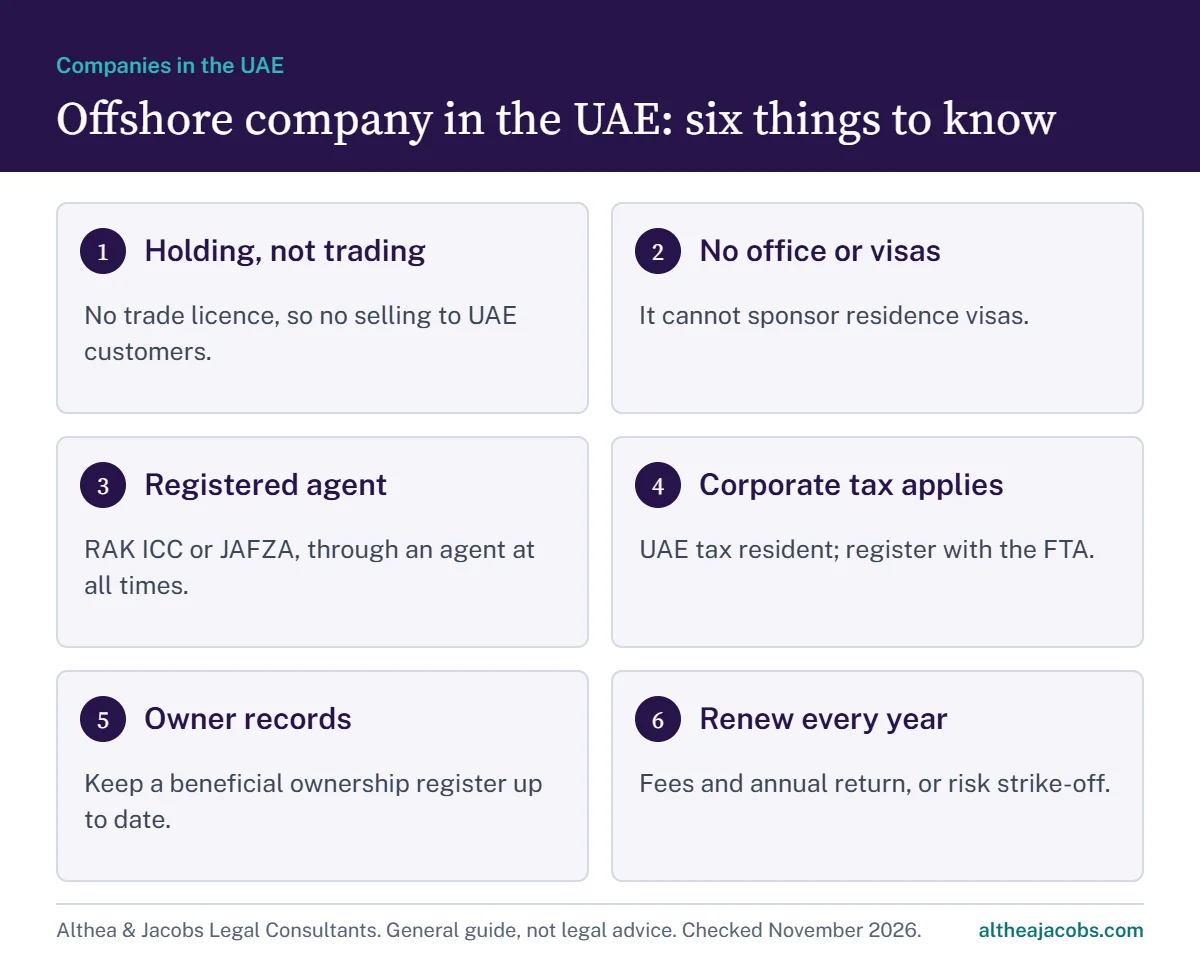
An offshore company in the UAE is a company registered with an offshore registry, mainly RAK ICC in Ras Al Khaimah or JAFZA Offshore in Jebel Ali, Dubai, to hold assets rather than trade. It gets a certificate of incorporation but no trade licence, office or visas, and it must always have a registered agent. Typical uses are holding shares in other companies, owning Dubai property in approved freehold areas, holding intellectual property and international investment. Offshore companies are treated as UAE tax resident for corporate tax and must register with the Federal Tax Authority. Economic substance reports are no longer required for years ending after 31 December 2022, but beneficial ownership records are.
Not sure if offshore is the right structure? The first consultation is free, and a lawyer calls back within 24 hours.
What an offshore company in the UAE is
A UAE offshore company is a legal entity incorporated under an offshore registry’s regulations. It is a separate company with its own shareholders and directors, but it exists to own and manage assets, not to run a trading business in the UAE. It receives a certificate of incorporation, not a trade licence, and its registered address is that of its registered agent.
Because it is incorporated in the UAE, an offshore company is not outside the UAE legal system. It has to keep records, maintain a beneficial ownership register, register for corporate tax and renew every year.
RAK ICC and JAFZA Offshore
| RAK ICC | JAFZA Offshore | |
|---|---|---|
| Where | Ras Al Khaimah | Jebel Ali Free Zone, Dubai |
| Rules | RAK ICC Business Companies Regulations 2018 | JAFZA Offshore Companies Regulations |
| Setup | Through a RAK ICC registered agent | Through a JAFZA registered agent on the Dubai Trade portal, typically 5 to 7 working days |
| Directors | At least one, including at least one individual | At least one director and one shareholder, plus a company secretary |
| Dubai property | Accepted by the Dubai Land Department with an approval, mainly where shareholders are individuals | Long accepted by the Dubai Land Department with an approval |
| Registration fee | Charged through agents | AED 10,000 listed by JAFZA |
Other emirates have offered offshore products in the past, but RAK ICC and JAFZA are the main registries in use today.
What an offshore company can do
- Hold shares in UAE and foreign companies, including operating companies, as a holding company.
- Own property in approved Dubai freehold areas, with the registry’s approval and Dubai Land Department registration, and property abroad.
- Hold intellectual property, such as trademarks, and license it to operating companies.
- Hold investments, such as portfolios and international assets.
- Keep a bank account for its routine transactions, subject to the bank’s own checks.
- Support succession planning, by holding family assets in one company whose shares can pass under a will or other planning documents.
If an offshore company will hold a UAE operating company, our guide to UAE company law for LLC owners explains the rules that apply to the company underneath.
What an offshore company cannot do
- Trade in the UAE. It has no trade licence, so it cannot sell goods or services to customers in the UAE. Under the RAK ICC regulations, it cannot do business with persons in RAK ICC’s zone without authorisation.
- Provide financial services, which RAK ICC companies are barred from doing anywhere in the world.
- Sponsor visas or rent an operating office. In practice, offshore companies do not get establishment cards, so they cannot sponsor residence visas.
- Act as a shortcut around licensing. If you need to trade, you need a trade license from a mainland or free zone authority.
Offshore vs free zone vs mainland
| Offshore | Free zone | Mainland | |
|---|---|---|---|
| Main purpose | Holding assets and shares | Trading mainly in the zone or abroad | Trading anywhere in the UAE |
| Trade licence | No | Yes | Yes |
| Office and visas | No | Yes | Yes |
| Corporate tax | Resident; standard rates | 0% on qualifying income possible with substance | Standard rates |
Our guide to mainland vs free zone companies in Dubai compares the two trading options in more detail.
Corporate tax and VAT for offshore companies
- Tax resident. The Federal Tax Authority’s guidance says offshore companies incorporated in the UAE are juridical persons, and UAE-incorporated companies are resident for corporate tax wherever they are managed.
- Registration. The FTA has confirmed that the registration deadlines apply equally to offshore companies. Late registration carries an AED 10,000 penalty.
- Rates. 0% on taxable income up to AED 375,000 and 9% above it.
- The free zone 0% rate. It applies only to Qualifying Free Zone Persons with adequate assets, staff and spending in a free zone. A company with no premises or staff will not normally meet that test.
- VAT. The normal rules apply: registration is mandatory above AED 375,000 of taxable supplies a year, which can matter if the company leases out commercial property.
Tax residency certificates for offshore companies have been restricted in the past, so check the FTA’s current practice before relying on one for a treaty claim.
Ongoing rules: agents, owners and records
- Registered agent. An offshore company must have a registered agent at all times; the agent handles filings with the registry.
- Annual renewal. Fees and an annual return are due every year, or the company can be struck off.
- Beneficial owners. Under Cabinet Decision No. 109 of 2023, companies must keep records of their beneficial owners, generally anyone with 25% or more, and keep them up to date.
- Economic substance. Reports are no longer required for financial years ending after 31 December 2022, under Cabinet Decision No. 98 of 2024.
- Records and audit. Keep proper accounts. JAFZA offshore companies must appoint an auditor and hold an annual general meeting.
- Anti-money laundering checks. Agents and banks will ask for passports, proof of address, source of funds and the purpose of the company.
Costs and setup
JAFZA lists a registration fee of AED 10,000 for an offshore company, plus small charges such as specimen signatures. RAK ICC fees are paid through registered agents and are commonly quoted at a few thousand dirhams for incorporation and renewal. Agent fees, the registered office, notarisation of documents and annual renewal come on top.
Opening a bank account can be the hardest step. Banks apply strict know-your-customer checks to companies with no local operations, so expect questions about the owners, the source of funds and what the company will hold. A clear structure chart and supporting documents make a big difference.
If you are buying Dubai property through an offshore company, plan the structure before you sign. Our notary public guide and power of attorney guide cover the documents you are likely to need.
Frequently asked questions
What is an offshore company in the UAE?
An offshore company is a company registered with a UAE offshore registry, mainly RAK International Corporate Centre (RAK ICC) or JAFZA Offshore in Jebel Ali, that is used to hold assets and investments rather than to trade in the UAE. It receives a certificate of incorporation, not a trade licence, and is managed through a registered agent.
Can an offshore company do business in the UAE?
Not as a trading business. An offshore company has no trade licence, so it cannot trade with customers in the UAE, lease commercial premises for operations or sponsor visas. It can hold shares in operating companies, hold property and intellectual property, and keep a bank account for its routine transactions.
Do offshore companies pay corporate tax in the UAE?
They can. The Federal Tax Authority treats offshore companies incorporated in the UAE as juridical persons resident in the UAE for corporate tax, and they must register. The standard rules apply: 0% on taxable income up to AED 375,000 and 9% above it. Without real substance in a free zone, an offshore company is unlikely to qualify for the 0% free zone rate.
Can an offshore company own property in Dubai?
Yes, in designated freehold areas, with an approval from the registry. The Dubai Land Department has registered property for JAFZA offshore companies for many years, and under its 2019 agreement with RAK ICC it accepts RAK ICC companies too, mainly where the shareholders are individuals.
How much does an offshore company in the UAE cost?
JAFZA lists a AED 10,000 registration fee for an offshore company. RAK ICC fees are charged through registered agents and are often quoted at a few thousand dirhams a year. Agent fees, the registered office and annual renewal are extra, so ask for a full first-year and yearly quote.
Do offshore companies still have to file economic substance reports?
No, for current years. Cabinet Decision No. 98 of 2024 removed economic substance notifications and reports for financial years ending after 31 December 2022. Earlier years are still subject to the old rules, and the company must still keep beneficial ownership records.
Related guides: Mainland vs free zone company in Dubai, Business setup cost in Dubai 2026 and UAE Company Law explained.
Get the right structure for your assets
Share your plans in confidence. A lawyer will call you back within 24 hours with advice on whether an offshore company suits you and what it will cost.
- 5.0 Google rating from 17 reviews
- Free first consultation
- Call back within 24 hours
“I really appreciate the honest advice and transparent pricing.”Sophia A., Google review
Office No. 18, 22nd Floor, Tower Plaza Hotel, Sheikh Zayed Road, Dubai. Monday to Friday, 9am to 6pm. The first consultation is free and confidential.
Request a call back
This guide is general information about UAE law and practice, not legal advice. Fees, procedures and online services change, so check the current position for your case or ask our team.
WhatsApp a lawyer