
By the Althea & Jacobs Legal Consultants team, Dubai
Last updated
An eviction notice in Dubai is one of the most stressful letters a tenant can receive, and one of the most misunderstood. A landlord cannot simply ask you to leave because they want a higher rent or a new tenant. Dubai’s tenancy law sets out a short list of reasons, strict notice periods and a specific way the notice has to be served, and an eviction only happens through the Rental Dispute Centre.
This guide explains when a landlord can legally evict a tenant in Dubai, how much notice is needed, how to check whether your notice is valid and what to do next, whether you are the tenant or the landlord. If you need advice on your own notice, our litigation lawyers in Dubai handle Rental Dispute Centre cases for tenants and landlords.
In Dubai, a landlord can evict a tenant before the lease ends only on specific grounds, such as rent not paid within 30 days of notice, unauthorised subletting or illegal use. At the end of the lease, the landlord can recover the property only to sell it, to use it personally or for a first-degree relative, or to demolish, rebuild or carry out major repairs, and must give at least 12 months’ written notice through a notary public or registered mail. If the tenant does not leave, the landlord must get a judgment from the Rental Dispute Centre. Self-help eviction, such as changing the locks, is not allowed.
Received an eviction notice? The first consultation is free, and a lawyer calls back within 24 hours.
The law on eviction in Dubai
Evictions in Dubai are governed by Law No. 26 of 2007 regulating the relationship between landlords and tenants, as amended by Law No. 33 of 2008. The key provision is Article 25, which lists every ground on which a landlord can ask for a tenant to be evicted. If the reason is not on that list, the landlord cannot evict, however the eviction notice in Dubai is worded.
Disputes are decided by the Rental Dispute Centre (RDC) at the Dubai Land Department. Properties in the Dubai International Financial Centre follow the DIFC’s own leasing law, so check where your property sits before relying on the rules below. Shared housing is also covered by Dubai Law No. 4 of 2026, in force since 26 August 2026, which requires permits and registration for shared units; it does not change the eviction notice rules below.
Eviction before the lease ends
While a lease is running, a landlord can ask the RDC to evict the tenant only on the grounds set out in Article 25(1). They are:
- Unpaid rent. The tenant does not pay the rent, or part of it, within 30 days after the landlord notifies them to pay, unless the parties agreed otherwise.
- Subletting without consent. The tenant sublets all or part of the property without the landlord’s written approval.
- Illegal use. The tenant uses the property, or allows it to be used, for an illegal purpose or one contrary to public order or morals.
- A different use. The tenant uses the property for a purpose other than the one agreed, or in a way that breaks Dubai’s planning and land-use rules.
- Empty commercial premises. A commercial property is left unused without a valid reason for 30 days in a row, or 90 days in total in a year.
- Damage or dangerous changes. The tenant makes changes that put the property’s safety at risk or cause damage that cannot be restored to its original state, or damages it deliberately or through gross negligence.
- Risk of collapse. A technical report approved by Dubai Municipality shows the building is at risk of collapse.
- Breach of the lease. The tenant breaks another obligation in the law or the lease and does not put it right within 30 days of being notified.
- Demolition ordered by an authority. A government authority requires the property to be demolished or rebuilt as part of urban development.
Unpaid rent is by far the most common ground. If a rent cheque bounces, the landlord can also pursue the cheque itself; our guide to bounced cheques in the UAE explains how that works alongside an eviction claim.
Eviction when the lease ends
Leases in Dubai are generally renewed unless the landlord has a legal reason to recover the property. Under Article 25(2), a landlord can ask for eviction at the end of the lease only if they:
- want to demolish the property to rebuild it, or add new construction that cannot be done with the tenant in it, with the necessary permits;
- need to carry out restoration or major maintenance that cannot be done while the property is occupied, supported by a technical report approved by Dubai Municipality;
- want to sell the property; or
- want to use the property themselves, or for a first-degree relative, who does not own another suitable property.
For all four grounds, the landlord must give the tenant at least 12 months’ written notice before the eviction date, stating the reason and served through a notary public or by registered mail. In practice the RDC looks at when the notice actually reached the tenant, so a landlord who serves late cannot expect the tenant to leave at the next expiry date.
A rent increase is not on this list. A landlord who wants more rent must follow the rental index rules and give 90 days’ notice before the lease expires, as explained in our guide to rent increases in Dubai. Refusing an increase the index does not allow is not a ground for eviction.
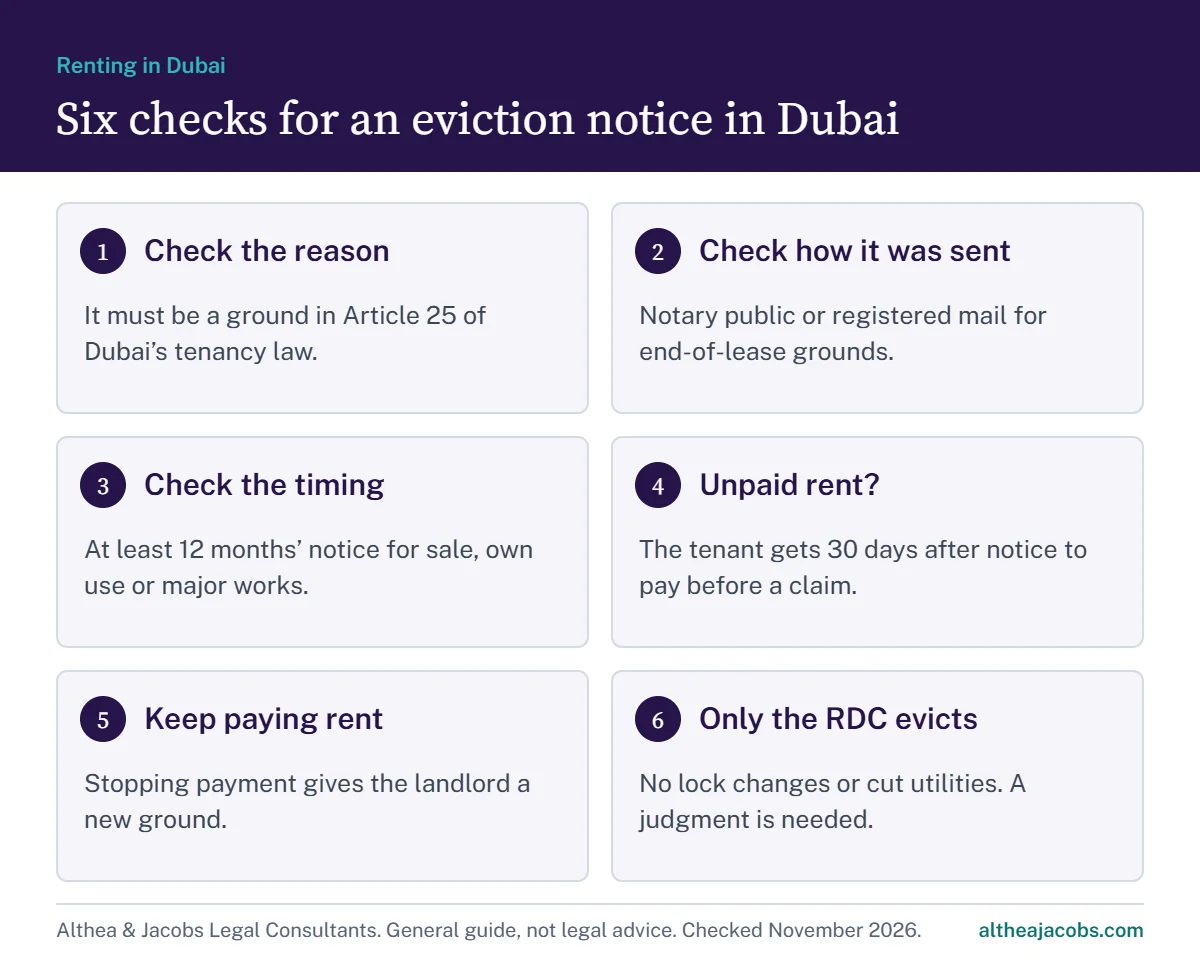
Is your eviction notice in Dubai valid?
Before you start packing, check the eviction notice against the law. Many notices that tenants receive would not survive a challenge at the RDC.
| Check | What the law expects |
|---|---|
| The reason | One of the grounds in Article 25, stated clearly in the notice |
| How it was served | Through a notary public or by registered mail for end-of-lease grounds; email or WhatsApp alone is not enough |
| The timing | At least 12 months before the eviction date for sale, personal use, demolition or major repairs |
| Unpaid rent | A notice giving the tenant 30 days to pay before an eviction claim can be filed |
| Personal use | The landlord or a first-degree relative will live in it, and they don’t own another suitable property |
| Repairs or demolition | Permits, or a technical report approved by Dubai Municipality showing the work can’t be done with the tenant in place |
If the notice fails any of these checks, it may not be enforceable, or it may only take effect at a later expiry date. The detail matters, so it is worth having a lawyer read it before you reply.
What to do if you receive an eviction notice in Dubai
- Don’t ignore it, and don’t sign anything yet. Note the date you received it and keep the envelope or notary record.
- Check the ground, the method and the dates against the table above.
- Keep paying the rent. Stopping payment hands the landlord a separate ground for eviction. If the landlord refuses your rent, ask whether it can be deposited with the RDC.
- Reply in writing. If you dispute the notice, say so clearly and keep proof of delivery. A formal legal notice can be the right tool.
- Negotiate if it suits you. Many evictions end in an agreement on a later move-out date, a rent-free period or the return of the deposit. Put any deal in writing.
- Get advice before the RDC hearing if the landlord files a case. You can defend the claim and, where appropriate, make your own claims, such as for your security deposit or compensation.
For landlords: how to evict a tenant properly
Most failed eviction claims fail on procedure, not on the merits. To recover your property without delay:
- Pick the right ground from Article 25, and make sure you can prove it, for example with a sale listing, a building permit or a technical report.
- Serve the eviction notice in Dubai correctly: through a notary public or registered mail, at least 12 months before the eviction date for end-of-lease grounds. A notary public in Dubai can serve and record it.
- For unpaid rent, send a clear notice to pay within 30 days before filing.
- Never take matters into your own hands. Article 34 of the law forbids cutting services or disturbing the tenant, and changing locks or removing belongings can lead to compensation claims and police complaints.
- File at the RDC if the tenant does not leave, with the Ejari-registered contract, the notice and proof of service.
If you recover a property to live in yourself or for a first-degree relative, Article 26 of the law stops you letting it to anyone else for at least two years for residential property, or three years for non-residential property, from the date you get it back. A tenant whose landlord breaks this rule can claim fair compensation at the RDC.
The Rental Dispute Centre process
If the tenant does not leave, the landlord files an eviction claim at the RDC, online through the Dubai Land Department or in person. The filing fee for rental claims is 3.5% of the annual rent, with a minimum of AED 500 and a maximum of AED 20,000, plus small administrative charges. The Centre first tries to settle the case, and if it settles at that stage, half the fee is refunded. Otherwise a judge-led committee hears both sides and gives a judgment.
Rental judgments in claims below AED 100,000 are usually final, but eviction judgments can be appealed within 15 days whatever the value of the claim. Once the judgment is final, it is enforced through the RDC’s execution department, not by the landlord personally. Our step-by-step guide to filing a rental dispute in Dubai covers documents, fees and timelines in more detail.
Common mistakes
- Tenants stopping rent in protest, which turns a weak eviction claim into a strong one.
- Landlords sending an eviction notice in Dubai by WhatsApp or email for end-of-lease grounds, which the RDC can reject.
- Counting the 12 months from the wrong date, for example from when the notice was signed rather than when it was delivered.
- Assuming a sale ends the lease. The buyer takes over the existing lease.
- Signing a move-out agreement without settling the security deposit, final bills and the handover condition in writing.
- Missing the 15-day appeal deadline after an eviction judgment.
When to speak to a lawyer
A short review early on often saves months. For tenants, a lawyer can tell you whether the notice is valid, how long you can stay and what to ask for in a negotiation. For landlords, a lawyer can choose the right ground, serve the notice correctly and prepare the RDC claim so that it succeeds the first time. Our team handles Rental Dispute Centre cases directly and works together with our UAE National Advocates where a matter goes on to the courts. Speak to our litigation team in Dubai.
Frequently asked questions
How much notice does a landlord need to give to evict a tenant in Dubai?
It depends on the reason. To end the lease when it expires because the landlord wants to sell, use the property personally or for a first-degree relative, demolish and rebuild, or carry out major repairs, the landlord must give at least 12 months’ written notice through a notary public or registered mail. For unpaid rent during the lease, the tenant is first given 30 days after being notified to pay before the landlord can ask the Rental Dispute Centre for eviction.
Is an eviction notice in Dubai valid if it is sent by WhatsApp or email?
Not for an eviction at the end of the lease. The law requires the 12-month notice to be served through a notary public or registered mail. A WhatsApp message or email can be useful evidence of what was said, but on its own it is not a valid eviction notice for these grounds.
Can a new owner evict me if the property is sold?
Not straight away. Under Article 28 of Dubai’s tenancy law, a change of ownership does not affect the tenant’s right to stay under the existing lease, so the new owner takes over the landlord’s position. A landlord who wants vacant possession to sell must give the 12-month notice before the lease expires; a buyer who wants to move in must follow the same rules as any landlord.
Can my landlord change the locks or cut the electricity?
No. A landlord cannot evict a tenant by changing the locks, removing belongings, or cutting off electricity, water or air conditioning. Article 34 of the tenancy law forbids the landlord from cutting services or disturbing your use of the property. Eviction needs a judgment from the Rental Dispute Centre, enforced through the Centre’s own execution department. If this happens to you, keep evidence, report it to the police and contact a lawyer immediately.
What can I do if the landlord evicted me for personal use and then rented the property out?
Under Article 26 of Dubai’s tenancy law, a landlord who recovers a property for personal use or for a first-degree relative cannot let it to someone else for at least two years for residential property, or three years for non-residential property. If they do, you can claim fair compensation at the Rental Dispute Centre. Keep the eviction notice and any evidence that the property was re-listed or re-let.
How long does an eviction case take at the Rental Dispute Centre?
Straightforward cases often finish within a few weeks to a few months of filing. Eviction judgments can be appealed within 15 days whatever the value of the claim, which adds time. The tenant usually stays in the property until the judgment is final and executed.
Related guides: Rental dispute in Dubai: how to file a case at the RDC, Dubai rent increase: what your landlord can legally ask and the RERA rent calculator.
Get advice on your eviction notice
Share the notice and your contract in confidence. A lawyer will call you back within 24 hours with a clear view of where you stand.
- 5.0 Google rating from 17 reviews
- Free first consultation
- Call back within 24 hours
“I really appreciate the honest advice and transparent pricing.”Sophia A., Google review
Office No. 18, 22nd Floor, Tower Plaza Hotel, Sheikh Zayed Road, Dubai. Monday to Friday, 9am to 6pm. The first consultation is free and confidential.
Request a call back
This guide is general information about UAE law and practice, not legal advice. Fees, procedures and online services change, so check the current position for your case or ask our team.
WhatsApp a lawyer