
By the Althea & Jacobs Legal Consultants team, Dubai
Last updated
If you are working out how to start a business in Dubai, you will find plenty of setup companies offering a licence in a few days. The licence is the easy part. The decisions that cost founders money later are legal ones: the structure, who owns what, which activities are on the licence, and what the contracts say when something goes wrong.
This guide walks through how to start a business in Dubai from a lawyer’s point of view, from choosing a structure to hiring your first employee, with the 2026 rules on ownership, tax and compliance. For advice on your own plans, our corporate and commercial lawyers in Dubai set up and restructure companies for founders, family businesses and international groups.
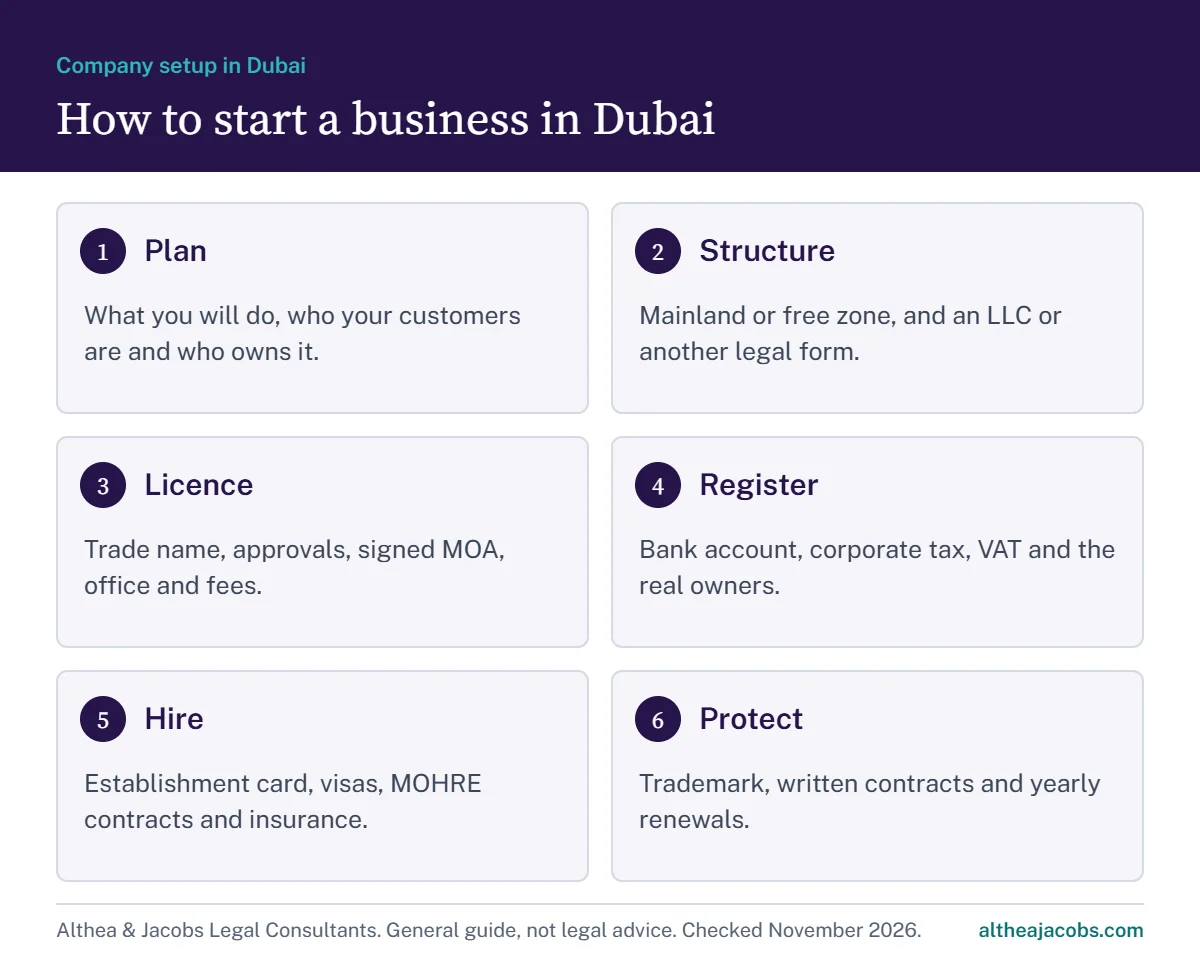
To start a business in Dubai, you decide what the business will do and where your customers are, choose between a mainland or free zone company and a legal form such as an LLC, reserve a trade name and get initial approval, sign the memorandum of association, lease an office and register it with Ejari, get any approvals your activity needs, and pay for the trade licence. After that you open a bank account, register for corporate tax (and VAT if your turnover passes AED 375,000), keep a register of the real owners, get the establishment card and visas, and put proper contracts in place with shareholders, staff and customers.
Planning a business in Dubai? The first consultation is free, and a lawyer calls back within 24 hours.
Start with the plan, not the licence
Before you decide how to start a business in Dubai, and before you speak to a free zone or a setup company, write down the answers to four questions. They decide almost everything that follows:
- What exactly will the business do? Every activity you list later on the licence has to match this.
- Who are the customers, and where are they? Selling to UAE consumers or the government points one way; serving clients abroad points another.
- Who will own it? One founder, several partners, a company abroad, or an investor coming in later.
- How many people will you employ in the first two years, and will you need an office they can work from?
How to start a business in Dubai: mainland, free zone and legal form
The first legal decision is where the company is licensed. A mainland company is licensed by the Department of Economy and Tourism and can trade anywhere in the UAE. A free zone company is licensed by its zone, such as DMCC, IFZA or the DIFC, and is designed mainly for business within the zone and abroad. Our guide to mainland vs free zone companies in Dubai compares the two, including the 2025 rules that let some free zone companies work on the mainland.
The second is the legal form. Most founders choose a limited liability company (LLC), because the owners’ liability is limited to their capital. A sole establishment is simpler but leaves the owner personally liable for the business’s debts. Professionals often use a civil company, and existing companies can open a branch. The types of trade license in Dubai follow from the activities you choose.
Ownership and the shareholder agreement
Federal Decree-Law No. 32 of 2021 on Commercial Companies allows 100% foreign ownership of mainland companies for most activities, and free zones have always allowed it. A short list of strategic activities still has conditions, and some professional licences held by foreign owners need a local service agent, who has no ownership.
If there is more than one owner, the memorandum of association is not enough on its own. It is a public document with standard wording. A shareholder agreement is where you agree the things that cause disputes later:
- who contributes what, and what happens if someone does not;
- who manages the company and which decisions need everyone’s approval;
- how profits are paid out;
- what happens if a partner wants to leave, dies or stops working in the business;
- whether a partner can compete with the company; and
- how disputes are resolved, for example through the courts or arbitration.
Getting the licence
- Choose the activities from the regulator’s activity list, checking ownership rules and any approvals from other authorities.
- Reserve the trade name and get initial approval on the Invest in Dubai platform for a mainland company, or through the free zone’s portal.
- Sign the legal documents. An LLC’s memorandum of association is signed before a notary public in Dubai. A shareholder abroad can sign through a power of attorney.
- Lease an office and register it with Ejari for a mainland company, or take a free zone office or flexi-desk.
- Get approvals from other authorities if your activity needs them.
- Pay the fees and receive the licence. It must be renewed every year; see our guide to trade license renewal in Dubai.
Bank account, tax and compliance
Once the licence is issued, several registrations follow quickly. Missing them is one of the most common reasons new companies receive fines in their first year, so they belong in any plan for how to start a business in Dubai.
| Requirement | What it means for a new business |
|---|---|
| Bank account | Banks ask for the licence, memorandum of association, proof of the office and details of the owners and the source of funds. Allow several weeks. |
| Corporate tax | Every company must register with the Federal Tax Authority. Tax is 0% on taxable income up to AED 375,000 and 9% above it. |
| Small Business Relief | Businesses with revenue of AED 3 million or less can elect it each year, for tax periods ending on or before 31 December 2029. It is not available to qualifying free zone companies. |
| VAT | Registration is mandatory once taxable supplies pass AED 375,000 a year, and optional from AED 187,500. The standard rate is 5%. |
| Real owners register | Keep a register of the ultimate beneficial owners, generally anyone with 25% or more, and file it with the licensing authority. |
| Accounting records | Keep proper books from day one. Some companies need audited accounts, including free zone companies claiming the 0% rate. |
Register for corporate tax on time: the Federal Tax Authority charges a penalty of AED 10,000 for late registration. Your accountant handles the filings, but the deadlines start with the licence date, so put them in your diary when the licence is issued.
Visas and hiring staff
To sponsor visas, the company first needs an establishment card from the immigration authority. Each visa then needs a quota, which on the mainland usually depends on the size of the office.
- Employment contracts for mainland companies are issued and registered through the Ministry of Human Resources and Emiratisation (MOHRE), and salaries are paid through the Wage Protection System.
- Health insurance is mandatory for employees in Dubai, paid by the employer.
- Job loss insurance (ILOE) is compulsory for most employees. The duty to subscribe and pay is the employee’s, but it helps to remind new staff. Our guide to ILOE claims in the UAE explains how it works.
- Emiratisation targets apply to mainland companies with 50 or more employees, which must raise skilled Emirati staff by 2% a year, and to companies with 20 to 49 employees in selected sectors.
- Write the key terms down: probation, notice, confidentiality and, where it is justified, a reasonable non-compete clause.
Protecting the business
- Register your brand as a trademark. A trade name on the licence is not a trademark, and someone else can register your brand. See our guide to brand registration in the UAE and run a UAE trademark search before you print anything.
- Use written contracts with customers and suppliers, with clear payment terms, limits on liability and the court or arbitration that will decide disputes.
- Keep the licence, visas and leases current. An expired licence can freeze bank accounts and visa processing.
- Get debt recovery right early. Clear invoices and payment terms make it far easier to use a payment order if a customer does not pay.
What it costs and how long it takes
The total depends on the structure, activities, office and number of visas, so treat online price tags with caution. Budget for:
- government fees for the trade name, initial approval and licence, and Dubai Chamber membership;
- the office lease and Ejari, or a free zone package;
- the establishment card, visas, medical tests and Emirates IDs;
- notarisation and translation of documents;
- professional fees for the legal documents, accounting and tax registrations; and
- the yearly renewal of the licence, lease and visas.
A simple licence can be issued within days. Being fully operational, with a bank account, visas and tax registrations, usually takes several weeks. Shareholders abroad, approvals from other authorities and bank compliance checks add time.
Common mistakes
- Choosing a structure on the first-year price without checking visas, office and renewal costs.
- Licence activities that don’t match the business, which can block contracts and bank accounts.
- No shareholder agreement between partners, or relying on the memorandum of association alone.
- Putting a nominee’s name on the company to get around rules, which leaves the real owner with no legal protection.
- Missing the corporate tax registration and paying the AED 10,000 penalty.
- Trading under a brand nobody has registered, then losing it to someone who did.
When to speak to a lawyer
You can work out how to start a business in Dubai and get a licence without a lawyer. Legal advice pays for itself when there are several owners, when your activity has ownership or approval conditions, when the structure affects tax and visas, or when you are moving an existing business to Dubai. Our corporate team advises on the structure, drafts the memorandum of association and shareholder agreement, handles the licensing and stays on as your company’s lawyer through an annual retainer. Speak to our corporate team in Dubai.
Frequently asked questions
Can a foreigner start a business in Dubai?
Yes. Foreign investors can own 100% of a mainland company for most activities under Federal Decree-Law No. 32 of 2021 on Commercial Companies, and free zones have always allowed full foreign ownership. A short list of activities still has ownership or approval conditions, so check your activity before you commit to a structure.
How long does it take to start a business in Dubai?
A simple licence can be issued within days, and the Instant Licence can be issued online in minutes for eligible activities. Getting fully operational, with a bank account, visas and tax registrations in place, usually takes several weeks, and longer if your activity needs approvals from other authorities or the shareholders are abroad.
How much does it cost to start a business in Dubai?
There is no single figure. The main costs are the government licence fees, the trade name and initial approval, Dubai Chamber membership, the office lease, visas, and professional fees for drafting documents. Ask any provider for the government fees, service fees, office and yearly renewal costs listed separately before you choose.
Do I need a local sponsor or partner to start a business in Dubai?
Not for most activities. Since 2021, most mainland activities allow full foreign ownership without an Emirati shareholder. Some professional licences held by foreign owners need a local service agent, who has no ownership and only helps with government procedures, and a short list of strategic activities has extra conditions.
Do I have to pay corporate tax on a new business in Dubai?
UAE corporate tax applies to businesses in Dubai, including most free zone companies. It is charged at 0% on taxable income up to AED 375,000 and 9% above that, and every company must register with the Federal Tax Authority, even if it expects to pay no tax. Small businesses with revenue of AED 3 million or less can elect Small Business Relief, which Ministerial Decision No. 131 of 2026 extended to tax periods ending on or before 31 December 2029.
Mainland or free zone: which is better for a new business?
It depends mostly on where your customers are. A mainland company can trade anywhere in the UAE and bid for government work, while a free zone company suits businesses that trade mainly abroad or within the zone. Our guide to mainland vs free zone companies in Dubai compares them under the 2026 rules.
Related guides: Business setup cost in Dubai 2026, UAE Company Law explained: key rules for LLC owners, Trade license in Dubai: types, rules and how to apply, Mainland vs free zone company in Dubai, Trade license renewal in Dubai and New UAE Civil Transactions Law: what changes for contracts.
Start your Dubai business on the right footing
Share your plans in confidence. A lawyer will call you back within 24 hours with the structure, documents and steps that fit.
- 5.0 Google rating from 17 reviews
- Free first consultation
- Call back within 24 hours
“I really appreciate the honest advice and transparent pricing.”Sophia A., Google review
Office No. 18, 22nd Floor, Tower Plaza Hotel, Sheikh Zayed Road, Dubai. Monday to Friday, 9am to 6pm. The first consultation is free and confidential.
Request a call back
This guide is general information about UAE law and practice, not legal advice. Fees, procedures and online services change, so check the current position for your case or ask our team.
WhatsApp a lawyer