
By the Althea & Jacobs Legal Consultants team, Dubai
Last updated
If you own or are setting up a limited liability company on the UAE mainland, UAE company law sets the rules you live by: who can own shares, how decisions are made, what has to happen every year, and what happens when things go wrong between shareholders.
The law was rewritten in 2021 and amended again in October 2025, with changes that bring onshore companies closer to international practice. This guide explains the key rules for LLC owners in plain English. For advice on your company’s documents, our corporate and commercial lawyers in Dubai advise founders, family businesses and investors across the UAE and India.
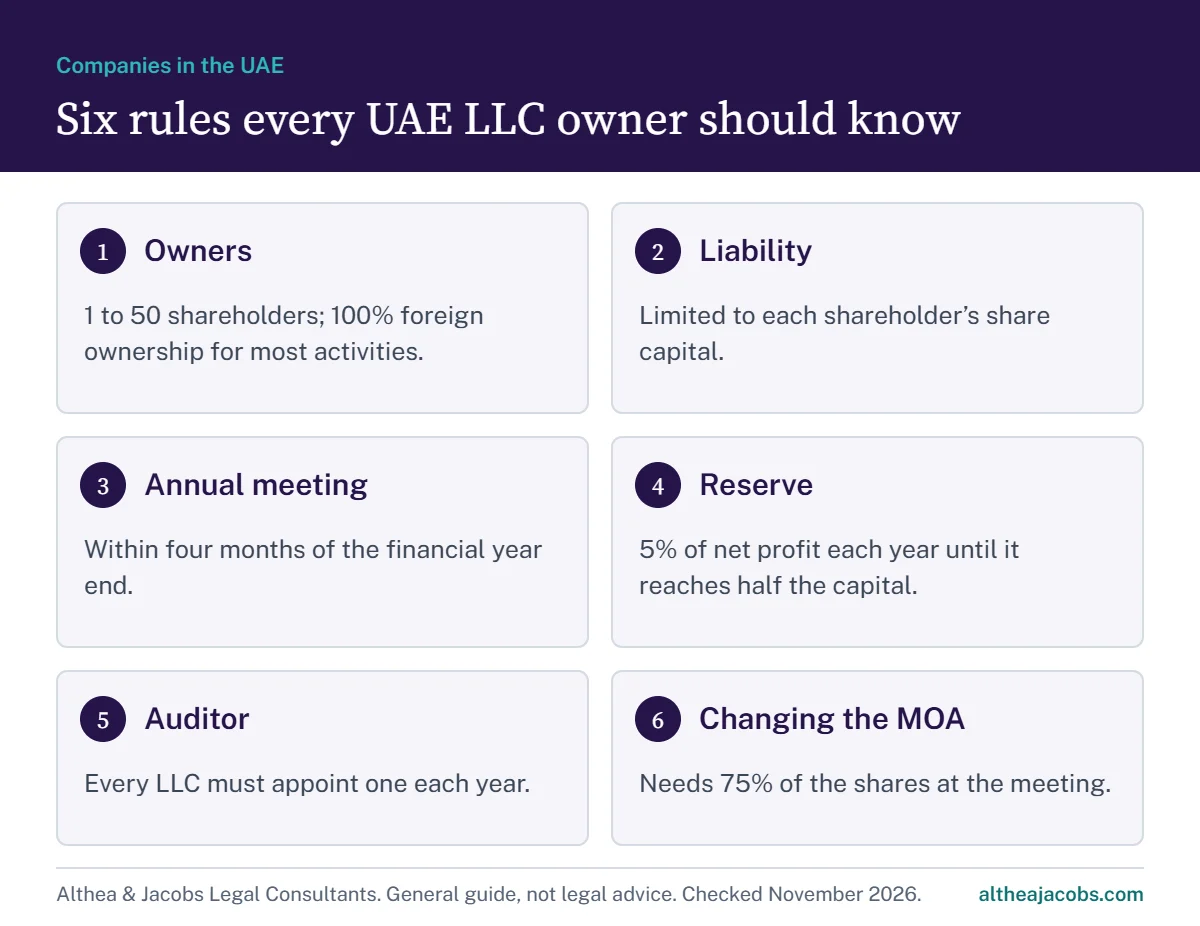
UAE company law is Federal Decree-Law No. 32 of 2021 on Commercial Companies, in force since 2 January 2022 and amended by Federal Decree-Law No. 20 of 2025 from 15 October 2025. It applies to mainland companies; free zones generally have their own rules. A mainland LLC can have 1 to 50 shareholders, whose liability is limited to their share capital, and foreigners can own 100% for most activities. Each year the company must hold a general assembly within four months of its financial year end, appoint an auditor and set aside 5% of net profit as a reserve until it reaches half the capital. Since October 2025, LLCs can also have share classes and drag-along and tag-along rights.
Need advice on your company’s set-up or documents? The first consultation is free, and a lawyer calls back within 24 hours.
What UAE company law is and where it applies
The main law is Federal Decree-Law No. 32 of 2021 on Commercial Companies, usually called the Commercial Companies Law. It came into force on 2 January 2022, replaced Federal Law No. 2 of 2015, and was amended by Federal Decree-Law No. 20 of 2025, in force since 15 October 2025.
- Mainland companies licensed by an emirate’s economic department, such as Dubai’s Department of Economy and Tourism, are governed by this law.
- Free zone companies generally follow their own free zone’s companies regulations instead. The DIFC and ADGM have their own company laws and courts. The federal law can apply where a free zone’s rules allow its companies to operate outside the zone.
- Some entities are excluded, including certain government-owned companies and companies in the oil and energy sector covered by special rules.
If you are still choosing where to set up, our guide to mainland vs free zone companies in Dubai compares the two.
The types of company under UAE company law
| Company type | In short |
|---|---|
| Limited liability company (LLC) | The most common form for private businesses. 1 to 50 shareholders, each liable only up to their share capital. |
| LLC (sole proprietorship) | An LLC owned by a single person or company, with the same limited liability. |
| Private joint stock company | For larger private businesses. Shares cannot be offered to the public. |
| Public joint stock company | Shares can be offered to the public and listed, under the Securities and Commodities Authority. |
| Joint liability company | A partnership of individuals who are personally liable for all the company’s debts. |
| Limited partnership | At least one partner with unlimited liability and others liable only up to their contribution. |
Branches of foreign companies and sole establishments are not companies under this law, but they are common alternatives. For most founders and small and medium businesses, the LLC is the right choice, so the rest of this guide focuses on it.
Key rules for LLCs
- Number of shareholders. Between one and 50. If the number goes above 50, the company must fix this or convert to a joint stock company.
- Limited liability. Each shareholder is liable for the company’s debts only up to the value of their shares, not with their personal assets, unless they have given personal guarantees or the corporate veil is lifted for fraud.
- Foreign ownership. Since 2021, foreign investors can own 100% of a mainland LLC for most activities. Activities with a “strategic impact” still have restrictions and need approvals.
- Share capital. The law sets no fixed minimum, but the capital must be sufficient for the company’s purpose and fully paid at incorporation. Cash contributions are deposited with a UAE bank. Contributions in kind are valued.
- Memorandum of association. The memorandum of association (MOA) is the company’s constitution. It sets out the shareholders, capital, activities, management and the rules on meetings, profits and share transfers. It is signed before a notary public and registered with the licensing authority.
- Managers. An LLC is run by one or more managers, who can be shareholders or outsiders, appointed in the MOA or by the general assembly.
- Supervisory board. An LLC with more than 15 shareholders must have a supervisory board made up of shareholders.
Our guide on how to start a business in Dubai walks through the set-up steps, and our guide to trade licences in Dubai covers the licence itself.
Meetings and decisions
Shareholders make the big decisions in the general assembly. Unless the MOA sets stricter rules, UAE company law provides:
- Notice. Shareholders must be invited at least 21 days before the meeting.
- Quorum. A meeting is valid if shareholders holding at least half the capital attend. If not, a second meeting held 5 to 15 days later is valid whoever attends.
- Ordinary decisions, such as approving accounts or appointing managers and auditors, need a majority of the shares represented at the meeting.
- Changes to the MOA, including changing the capital, need shareholders holding at least 75% of the shares represented at the meeting. A shareholder’s financial obligations cannot be increased without their consent.
- Requesting a meeting. Shareholders holding at least 10% of the capital can ask for a general assembly to be called.
Many disputes come from an MOA that copies the default wording without thinking about deadlock, minority protection or exit. If there are several shareholders, a separate shareholder agreement that reflects the commercial deal is usually worth having.
What an LLC must do every year
- Prepare accounts within three months of the financial year end, and keep accounting records for at least five years.
- Appoint an auditor. Every LLC must have an auditor, appointed each year by the general assembly.
- Hold the annual general assembly within four months of the financial year end, to approve the accounts and the auditor’s report.
- Set aside a statutory reserve. Transfer 5% of net profit each year to a reserve, until the reserve reaches half the share capital.
- Keep registers up to date. Maintain the register of partners and the register of beneficial owners, and file updates with the licensing authority within 15 days of a change.
- Renew the trade licence and keep other registrations current. Our guide to trade licence renewal in Dubai explains the steps.
- Corporate tax. Register and file returns. Corporate tax is 9% on taxable income above AED 375,000, and 0% up to that amount.
Selling or transferring shares in an LLC
Shares in an LLC are not freely transferable like listed shares. Under UAE company law:
- Pre-emption rights. If a shareholder wants to sell to an outsider, the other shareholders have 30 days to buy the shares first. If they cannot agree on the price, it is set by an expert valuation.
- Formalities. A share transfer must be documented before a notary public and only takes effect against the company and third parties once it is recorded with the licensing authority.
- Drag-along and tag-along. Since October 2025, the MOA can allow a majority seller to require minority shareholders to sell on the same terms (drag-along), or allow minority shareholders to join a sale (tag-along). Because statutory pre-emption still applies, lawyers often add a waiver too.
- Death of a shareholder. The MOA can now give the remaining shareholders or the company a right to buy a deceased shareholder’s shares.
What changed in UAE company law in October 2025
Federal Decree-Law No. 20 of 2025 made several changes that matter to LLC owners:
- Share classes. LLCs can now issue different classes of shares with different voting, dividend, redemption or liquidation rights, set out in the MOA. This makes it easier to bring in investors on agreed terms.
- Drag-along and tag-along rights can be included in the constitutional documents of LLCs and private joint stock companies.
- Re-domiciliation. A company can move from one emirate to another, or between the mainland and a free zone, keeping the same legal identity, instead of closing and starting again.
- Deadlock. Where shareholder disputes paralyse a company, the licensing authority can appoint independent managers for a limited period.
- Non-profit companies. A new form of company that reinvests its profits rather than distributing them.
- Easier conversion of an LLC into a joint stock company, and private placements for private joint stock companies.
Some of these changes, including share classes, re-domiciliation and non-profit companies, depend on implementing rules from the Cabinet or the Ministry of Economy and Tourism. Check the current position before relying on them, and update your MOA rather than assuming the new options apply automatically.
Losses, disputes and managers’ liability
- Losses of half the capital. If an LLC’s losses reach half its share capital, the managers must ask the general assembly to decide whether to continue or dissolve the company.
- Losses of three-quarters. If losses reach three-quarters of the capital, shareholders holding a quarter of the capital can ask for the company to be dissolved.
- Managers’ liability. Managers are liable to the company, the shareholders and third parties for fraud, misuse of power, breaches of the law or the MOA, and gross mistakes. A clause in the MOA that excludes this liability is void.
- Disputes. Shareholder disputes go to the courts, or to arbitration if the MOA or a shareholder agreement says so. Court work is handled together with our UAE National Advocates.
- Fines. The law allows administrative fines for breaches, so filings, registers and annual steps are worth keeping on top of.
Contracts your company signs are also governed by the new UAE Civil Transactions Law, and if your company handles personal data, our guide to the UAE Data Protection Law explains what to put in place.
When to speak to a lawyer
Legal advice is worth it when you draft or amend an MOA, bring in a new shareholder or investor, sell or transfer shares, want to use the new share classes or exit rights, move your company to another emirate or free zone, or face a dispute between shareholders. Many clients keep us on an annual retainer so company changes and contracts are checked before they are signed. Speak to our corporate and commercial team in Dubai.
Frequently asked questions
What is the UAE Commercial Companies Law?
The UAE Commercial Companies Law is Federal Decree-Law No. 32 of 2021, in force since 2 January 2022. It governs how companies are formed, owned, managed and closed on the UAE mainland, including limited liability companies (LLCs). It replaced Federal Law No. 2 of 2015 and was amended by Federal Decree-Law No. 20 of 2025, in force since 15 October 2025.
Does UAE company law apply to free zone companies?
Generally not, where the free zone has its own companies rules. Free zone companies follow their free zone’s regulations, and the DIFC and ADGM have their own company laws. The federal law can still apply where a free zone’s rules allow its companies to operate outside the zone, and since October 2025 the law has allowed companies to move between the mainland and free zones.
How many shareholders can a UAE LLC have?
An LLC on the UAE mainland can have between one and 50 shareholders. A company owned by a single person is registered as a limited liability company (sole proprietorship). If the number goes above 50, the company must fix the position or convert to another legal form.
Can foreigners own 100% of a mainland company in the UAE?
Yes, for most activities. Since 2021, the requirement for a UAE national to hold 51% of a mainland LLC has been removed for most activities, so foreign investors can own 100%. Activities listed as having a strategic impact, such as some in security, defence and energy, still have ownership restrictions and approvals.
Is there a minimum share capital for an LLC in the UAE?
The federal law does not set a fixed minimum. It requires the capital to be sufficient for the company’s purpose and fully paid at incorporation. The licensing authority or the activity may require a specific amount, so check before you set it in the memorandum of association.
What changed in UAE company law in 2025?
Federal Decree-Law No. 20 of 2025, in force since 15 October 2025, allows LLCs to have different share classes, lets companies include drag-along and tag-along rights, introduces non-profit companies, allows companies to move between emirates and between the mainland and free zones, and adds a way to resolve shareholder deadlock. Several of these changes depend on implementing rules.
Related guides: Offshore company in the UAE, How to start a business in Dubai, Mainland vs free zone company in Dubai and New UAE Civil Transactions Law.
Get your company’s documents right
Share your memorandum of association or your plans in confidence. A lawyer will call you back within 24 hours with what needs attention.
- 5.0 Google rating from 17 reviews
- Free first consultation
- Call back within 24 hours
“I really appreciate the honest advice and transparent pricing.”Sophia A., Google review
Office No. 18, 22nd Floor, Tower Plaza Hotel, Sheikh Zayed Road, Dubai. Monday to Friday, 9am to 6pm. The first consultation is free and confidential.
Request a call back
This guide is general information about UAE law and practice, not legal advice. Fees, procedures and online services change, so check the current position for your case or ask our team.
WhatsApp a lawyer