
By the Althea & Jacobs Legal Consultants team, Dubai
Last updated
The UAE Civil Transactions Law is the law behind almost every contract in the country: sales, services, leases, loans, guarantees and construction. On 1 June 2026 a new version came into force, replacing the 1985 law that courts and businesses had relied on for four decades.
Most of the old principles survive, but several changes affect how contracts are negotiated, drafted and enforced. This guide explains what is new for businesses and individuals, and what to check in your contracts. To have your own contracts reviewed, our corporate and commercial lawyers in Dubai advise companies across the UAE and India.
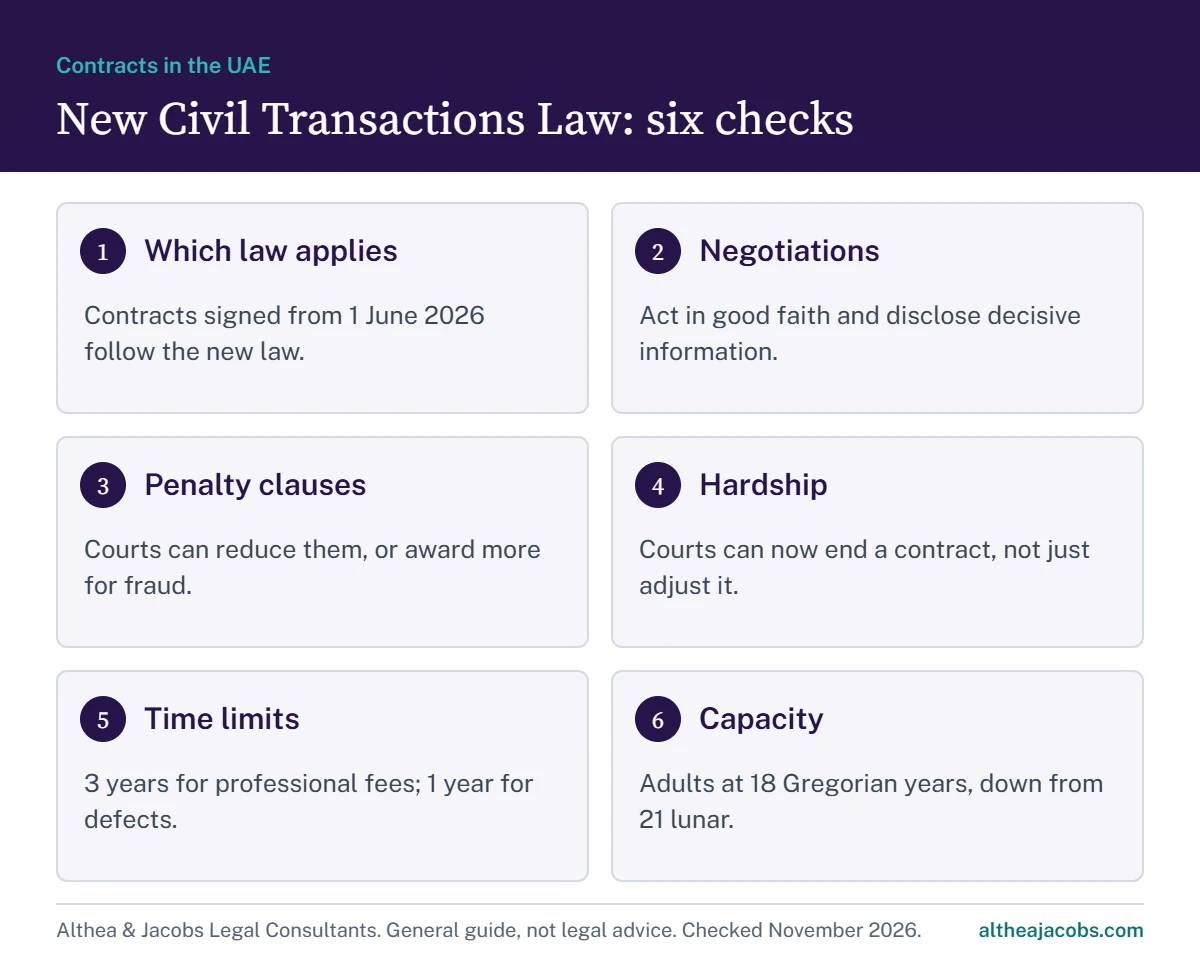
The new UAE Civil Transactions Law (Federal Decree-Law No. 25 of 2025) has applied since 1 June 2026 to contracts concluded on or after that date; older contracts stay under the 1985 law. The main changes are: the age of majority falls to 18 Gregorian years; parties must negotiate in good faith and disclose information that would decide the other side’s consent; courts can still reduce excessive penalty clauses, and a creditor can claim more if it proves fraud or gross fault; courts can now end a contract for unforeseeable hardship, not just reduce the obligation; the window to claim for hidden defects in goods rises to one year; and the limitation period for professional fees falls to three years.
Want your contracts checked against the new law? The first consultation is free, and a lawyer calls back within 24 hours.
What the UAE Civil Transactions Law is, and when the new one applies
The Civil Transactions Law is the UAE’s civil code. It sets the general rules on how contracts are formed and interpreted, what happens when one side does not perform, compensation for harm, and the rules for common contracts such as sale, lease, agency, guarantee and construction. Commercial matters between traders are also governed by the Commercial Transactions Law (Federal Decree-Law No. 50 of 2022), but the civil code fills the gaps.
The new law was issued as Federal Decree-Law No. 25 of 2025, announced at the end of 2025, and came into force on 1 June 2026. It repealed Federal Law No. 5 of 1985 and its amendments.
- Contracts signed before 1 June 2026 generally stay under the 1985 law. The new law does not apply retroactively.
- Contracts signed on or after 1 June 2026 fall under the new law, including renewals and new contracts made under an older framework agreement.
- Limitation periods already running on 1 June 2026 are governed by the new periods. Where a new period is shorter, it runs from 1 June 2026, unless the old period would have ended sooner.
- Long-term contracts, such as multi-year supply, lease or construction agreements, are where disputes over which law applies are most likely. Record the date of any amendment or renewal carefully.
The order in which courts look for an answer also stays familiar: first the legislation, then Islamic Sharia, then custom, then the principles of natural law and justice. Under the new law, when applying Sharia the court is not limited to one school of thought and chooses the solution that best serves the public interest.
Age of majority and legal capacity
One of the most visible changes in the UAE Civil Transactions Law is the age of majority. It is now 18 Gregorian years, down from 21 lunar years (roughly 20 years and 4 months) under the old law. From 18, a person of sound mind can sign contracts, open accounts and deal with property in their own name.
- A minor aged 15 or over can apply to the court for permission to manage their own assets, down from 18 under the old rules.
- Where a minor who understands what they are doing enters into a transaction that could benefit or harm them, such as a sale, the transaction is now valid but can be cancelled. The guardian can ask the court to cancel it within one year of learning about it, and the minor within one year of turning 18.
- Businesses that deal with young customers, tenants, employees or investors aged 18 to 21 can now contract with them directly, without a guardian.
Negotiation, good faith and disclosure
The old law said little about the stage before a contract is signed. The new UAE Civil Transactions Law makes negotiations a source of legal liability in their own right:
- Good faith in negotiations (Article 121). A party that negotiates, or breaks off negotiations, in bad faith must compensate the other side for its actual loss. Lost expected profit is not recoverable unless the parties agreed otherwise. Deliberately hiding a material fact counts as bad faith.
- A duty to disclose (Article 122). Each party must disclose information it knows, or should know, that would decide the other side’s consent. This duty cannot be excluded or limited by contract, and the harmed party can ask the court to cancel the contract.
- Confidentiality. Confidential information shared during negotiations must not be disclosed or misused, whether or not a contract is signed.
- How agreement is given. Consent can be given in words, in writing, by conduct or by implication, and silence can count as acceptance where previous dealings or custom support it. Goods or services displayed with a price are generally treated as a binding offer.
- Framework agreements. Where parties sign a framework agreement, its basic terms automatically form part of each later contract made under it.
In practice, this means letters of intent, memoranda of understanding, heads of terms and reservation agreements carry more legal weight than before. Keep a written record of what was said and shared during negotiations, and say clearly in writing when a document is not meant to be binding.
Standard terms and how contracts are interpreted
Many businesses rely on standard terms that the customer cannot negotiate, such as online terms and conditions, supply terms or tenancy forms. Like the old law, the new UAE Civil Transactions Law protects the party who had no say in the wording:
- The court can amend unfair terms in a standard-form contract, or release the weaker party from them.
- Ambiguous wording in a standard-form contract is read in favour of the party who had to accept it.
- Where the wording is clear, it is applied as written. Where it is not, the court looks for the parties’ common intention, guided by the nature of the deal, good faith and custom.
- Contracts must be performed in good faith, in line with what they say and what the nature of the deal requires.
The lesson is simple: draft clearly. The more a court has to interpret, the more the outcome depends on the general rules rather than on what you meant.
Penalty clauses and damages under the UAE Civil Transactions Law
Many UAE contracts fix the compensation in advance: delay penalties, late-payment charges, cancellation fees or liquidated damages. The 1985 law let courts adjust these amounts to match the actual loss. The new rule, in Article 340, keeps that approach and adds to it:
| Situation | What the court can do |
|---|---|
| The agreed amount is excessive | Reduce it to a fair level. |
| The obligation was partly performed | Reduce the agreed amount accordingly. |
| The creditor contributed to the loss | Reduce the compensation, or refuse it. |
| The debtor committed fraud or gross fault | Award more than the agreed amount, if the creditor proves its loss. |
| The contract says the court cannot adjust | Ignore that wording. Any agreement against these rules is void. |
Two practical points follow. First, a liquidated damages figure is not a guaranteed cap on liability where the other side can show fraud or gross fault, which matters most in construction and supply contracts. Second, a penalty that is far above any realistic loss is likely to be reduced, so set amounts you can justify with a genuine estimate.
Hardship and force majeure
Both the old and new laws distinguish between an event that makes performance impossible and one that makes it much more burdensome.
- Hardship (Article 224). If a general, exceptional event that could not have been foreseen makes performance so onerous that it threatens the burdened party with serious loss, the court can reduce that obligation to a reasonable level. Under the new law, the court can also end the contract, which the old law did not allow.
- Force majeure. If performance becomes impossible for a reason outside the debtor’s control, the obligation ends and the contract is cancelled automatically. If only part becomes impossible, only that part ends. Where the impossibility is temporary in a continuing contract, such as a lease or a supply agreement, the contract can be adjusted instead.
- Construction. Rising prices on their own are not enough. But where unforeseeable general circumstances upset the balance of a construction contract, the court can extend the time for completion, adjust the price or end the contract.
Your contract can still define force majeure events, notice requirements and what happens to payments. A clear clause gives both sides certainty, rather than leaving the outcome to the court.
Limitation periods: how long you have to claim
The new UAE Civil Transactions Law keeps the general 15-year limitation period, but changes several of the shorter ones:
- 15 years remains the general period for contractual claims.
- 5 years for periodic payments such as rent and instalments.
- 3 years for professional fees, such as fees charged by members of the liberal professions, down from 5 years.
- 2 years for claims by traders, hotels and restaurants for goods and services supplied, and for wages.
- 3 years for harm outside a contract, running from the day the injured person learned of the harm and who caused it, with a 15-year long-stop.
- 1 year to claim for hidden defects in goods sold, running from delivery, up from 6 months.
If you have an unpaid invoice or a claim in mind, check the deadline now. Sending a legal notice is usually the first step, and a payment order or a civil case may follow.
Sales, guarantees, leases and construction
The new law also updates the rules for specific contracts. The changes most businesses will notice are:
- Sale of goods. The buyer of goods with a hidden defect now has one year from delivery to claim, and can reject the goods, ask for a price reduction or, where possible, ask for a replacement.
- Guarantees. A guarantor who is not jointly liable can insist that the creditor first pursues the principal debtor and the debtor’s assets.
- Powers of attorney. A general agency covers managing and preserving property. Selling, mortgaging or settling on someone’s behalf needs a specific power. Check that any power of attorney you rely on names the acts it will be used for.
- Leases. The civil code’s lease rules apply where an emirate’s own landlord and tenant law does not cover the issue. For residential and commercial tenancies in Dubai, start with Dubai’s tenancy law; our guides to eviction notices in Dubai and rent increases in Dubai explain the main rules.
- Construction. Contractors and supervising engineers remain jointly liable for 10 years for the total or partial collapse of buildings and structures, and for defects that threaten their stability (Articles 821 to 824). Subcontractors are not covered by this liability, so main contractors should pass the risk down in their subcontracts.
What to check in your contracts
You do not need to rewrite contracts signed before 1 June 2026, but new contracts, renewals and templates should reflect the new UAE Civil Transactions Law. A practical review covers:
- Which law applies. List your long-term contracts and note which were signed, renewed or amended after 1 June 2026.
- Templates. Update standard terms, supply and service agreements, agency and distribution agreements, leases and subcontracts.
- Penalty and liquidated damages clauses. Set amounts you can justify, and do not rely on them as a firm cap.
- Hardship and force majeure clauses. Define the events, notice periods and consequences clearly.
- Negotiation documents. Mark letters of intent and heads of terms clearly as binding or non-binding, and keep records of what was disclosed.
- Powers of attorney and signatories. Make sure they cover the specific acts they are used for.
- Claims and invoices. Diarise the shorter limitation periods, especially the 3 years for professional fees.
- Counterparties aged 18 to 21. Update onboarding checks that assumed the old age of majority.
When to speak to a lawyer
The new UAE Civil Transactions Law is long and detailed, and courts will take time to settle how some of the new rules apply. Legal advice is worth it before you sign a significant contract, when you update the templates your business uses every day, or when a dispute arises over a contract signed around the change. Our corporate team reviews and drafts commercial contracts, and many clients keep us on an annual retainer so every contract is checked before it is signed. Speak to our corporate and commercial team in Dubai.
If you are setting up a new company, our guide on how to start a business in Dubai covers the contracts to put in place from day one.
Frequently asked questions
When did the new UAE Civil Transactions Law come into force?
The new UAE Civil Transactions Law, issued as Federal Decree-Law No. 25 of 2025, came into force on 1 June 2026. It replaced Federal Law No. 5 of 1985, which had governed contracts, obligations and civil liability in the UAE for about 40 years.
Does the new Civil Transactions Law apply to contracts signed before 1 June 2026?
Generally, no. The new law does not apply retroactively, so a contract concluded before 1 June 2026 stays under the 1985 law. Contracts signed, renewed or substantially amended on or after that date fall under the new law, and long-term contracts can raise questions about which law governs, so check each one.
What is the age of majority under the new UAE Civil Transactions Law?
The age of majority is now 18 Gregorian years, down from 21 lunar years under the 1985 law. A person aged 18 can therefore sign binding contracts in their own name, and a minor aged 15 or over can ask the court for permission to manage their own money.
Can a court still reduce a penalty or liquidated damages clause in the UAE?
Yes. Under Article 340 of the new law, a court can reduce agreed compensation that is excessive or where the contract was partly performed, and can reduce or refuse it where the creditor contributed to the loss. The creditor can claim more than the agreed amount if it proves fraud or gross fault. The parties cannot contract out of these rules.
What happens if circumstances change after a contract is signed?
If a general, exceptional event that nobody could have foreseen makes performance extremely burdensome, though not impossible, the court can reduce the burdened party’s obligation to a reasonable level and, under the new law, can also end the contract. If performance becomes impossible, the obligation ends and the contract is cancelled automatically.
Do I need to update my company’s contract templates?
Most businesses should review them. The new law adds duties of good faith and disclosure during negotiations, changes how courts treat penalty clauses and hardship, and shortens some limitation periods. Templates for supply, services, agency, construction and lease agreements are the usual priorities.
Related guides: UAE Company Law explained, UAE Data Protection Law (PDPL), How to start a business in Dubai, Legal notice in the UAE and Payment order in the UAE.
Make sure your contracts work under the new law
Share your contract or template in confidence. A lawyer will call you back within 24 hours with what needs to change.
- 5.0 Google rating from 17 reviews
- Free first consultation
- Call back within 24 hours
“I really appreciate the honest advice and transparent pricing.”Sophia A., Google review
Office No. 18, 22nd Floor, Tower Plaza Hotel, Sheikh Zayed Road, Dubai. Monday to Friday, 9am to 6pm. The first consultation is free and confidential.
Request a call back
This guide is general information about UAE law and practice, not legal advice. Fees, procedures and online services change, so check the current position for your case or ask our team.
WhatsApp a lawyer